



I wrote an article recently about why the New Atheists made a big mistake leaning into the “God of the gaps” fallacy. Atheists often accuse science-oriented Christians like me of engaging in it, which I find both weird and amusing. If you don’t know what I’m talking about, the idea is that science keeps filling in the gaps in our knowledge God once occupied, and one day science will explain everything and leave no room for God.
For instance, where thunder and lightning were once the province of Thor (not exactly the Christian God, but we’ll give the critics a pass), science now explains them as natural phenomena. Gap filled. People supposedly once thought angels pushed the planets around the heavens, but we now know the universal law of gravitation does the job. Another gap filled. I’m not sure what other natural phenomena were routinely chalked up to “God did it,” but according to my atheist critics this was a major thing at one time.
Never mind that the pagan Greeks had been proposing naturalistic explanations since Thales of Miletus in the 7th century BC. Or that the Church in the 13th century incorporated Aristotelian philosophy—including most of its scientific ideas—into Christian theology, particularly through thinkers like Thomas Aquinas. So Christians weren’t, as a matter of doctrine, plugging every hole in human knowledge with “God did it” despite what snarkybob347852 on Reddit insists.
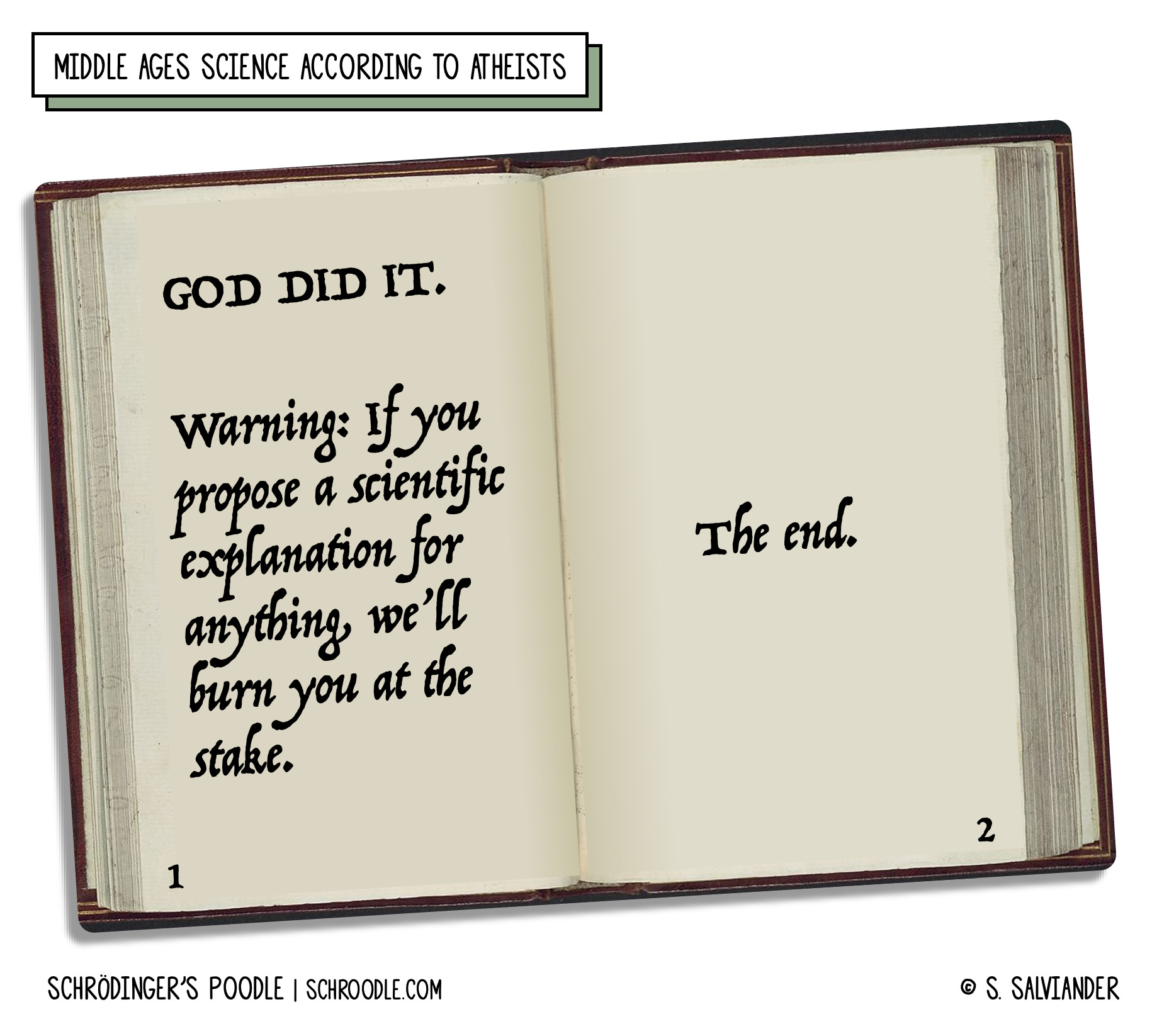
The truth is, Christians in the 11th–12th centuries started the university system. The core subjects included the quadrivium of arithmetic, geometry, music, and astronomy. As atheist historian Tim O’Neill has tried to explain to his fellow atheists, from the 11th to the 16th centuries there were incredible pre-modern scientific developments in Christendom. These included advances in optics (by figures like Robert Grosseteste and Roger Bacon), the development of the scientific method’s precursors, mathematical innovations, mechanics and dynamics (e.g. the work of Jean Buridan and Nicole Oresme on impetus theory), astronomy, medicine, and more. This just makes sense. You don’t get modern science suddenly appearing fully formed with Copernicus out of nowhere. It was the culmination of centuries of progression in scientific thinking within a Christian intellectual culture.1
So, the main problems with the “God of the gaps” accusation are:
Christians weren’t really using it as a matter of course.
There are some gaps that science will never fill, no matter how advanced it gets.
Scientific explanations often raise more questions than they answer.
For #2, as I wrote in my earlier article:
Science excels at describing how things behave once they exist—through observation, experimentation, and repeatable laws—but it can’t address what caused the universe to exist in the first place. Things don’t pop into being from nothing, uncaused. There must be a cause outside the universe itself. And since empirical observation is a cornerstone of the scientific method, we have no way to observe or test what transcends the cosmos. That question sits forever beyond science’s reach.
This makes a lot of people uncomfortable. The idea that the universe was eternal, uncreated, and unchanging persisted for nearly two thousand years. The Church both rejected and grappled with this idea, and when it scientifically collapsed in the 1960s with the rise of Big Bang cosmology, many scientists were deeply unhappy. As John Maddox, the editor of the prestigious scientific journal, Nature, put it in a 1989 editorial, the Big Bang was “philosophically unacceptable” and an “over-simple view” unlikely to survive the decade. (As the kids on the internet say, that didn’t age well.)
Why the resistance? Two reasons. First, it’s philosophically untidy—scientists dislike loose ends, and a cosmic-sized one like the universe’s origin is hard to ignore. Second, it sounds uncomfortably like Genesis 1:1. As Nobel laureate physicist George Paget Thomson (a Christian) observed, probably every scientist would accept a beginning to the universe if the Bible hadn’t mentioned it first. Genesis added a lot of baggage for secular scientists.
For #3, there are plenty of examples. Take gravity. Newton developed his universal theory in the 17th century, elegantly explaining planetary motions. But it was weirder than “God moves them.” How do distant objects influence each other without touching? How does the Sun, 93 million miles away, exert an invisible pull on Earth? Scientists at the time were profoundly disturbed by this. Score: One question answered; but a stranger one took its place.
Einstein’s general relativity later explained gravity as spacetime curvature. But it raised new puzzles: Why is the universe expanding despite gravity’s pull? Why is the expansion accelerating? What happens at the singularity of a black hole? Is information lost inside them? Score: One question answered; several more raised.
Special relativity? Don’t get me started—the bane of every sophomore physics student. It nicely resolved inconsistencies in Maxwell’s electromagnetism (e.g. the constant speed of light regardless of the observer’s motion) but introduced mind-bending concepts like relativity of simultaneity, time dilation, length contraction, and the twin paradox. Score: One (or a few) questions answered; many more raised.
Statistical mechanics, the roided-up cousin of thermodynamics, capably bridges the microscopic and macroscopic worlds. But in doing so, it also suggests incredibly weird things, like it’s more probable that you’re a brain that spontaneously fluctuated into existence—complete with false memories—than that the entire ordered universe came into being. This is the infamous Boltzmann Brain (or “brain in a vat”) problem. For all its explanatory power, statistical mechanics raises a multitude of absurd possibilities, like “Is any of this real?” Score: A few questions answered; many more (and far more absurd) questions raised.
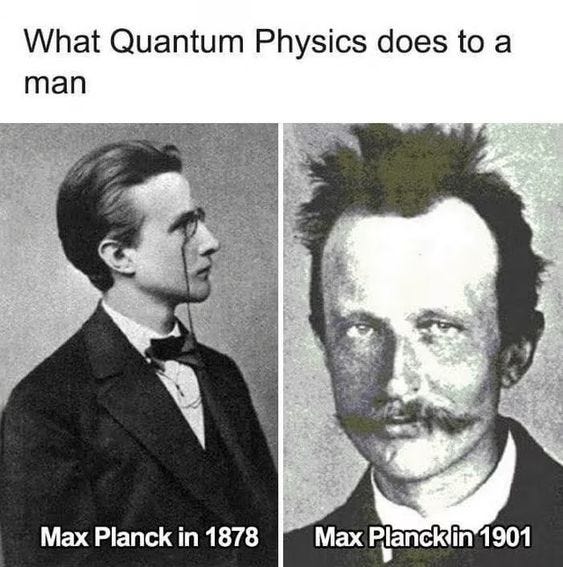
But quantum mechanics takes the cake for raising more questions than it answers. It provides incredibly accurate mathematical predictions for particle-level phenomena, but offers no intuitive “this is how it really works” explanation. Instead, we get wave-particle duality, the double-slit experiment (where particles behave like waves until observed), quantization of energy, quantum entanglement (“spooky action at a distance”), quantum tunneling, superposition, and many more. Physicists often compare all this to the absurdity of Alice in Wonderland just to make it relatable.
Attempts to make sense of quantum weirdness via “interpretations” have only multiplied the philosophical headaches. There are dozens of interpretations (polls and lists commonly highlight 8–15 major ones, with many variants). Key examples include the Copenhagen Interpretation (the pragmatic “shut up and calculate” favorite for many physicists), the Many-Worlds Interpretation (the multiverse), Pilot-Wave (Bohmian) theory, and others. Score: A few questions answered; many more—and far weirder—raised.
I’ve noticed a lot of atheists take the reverse approach—what some Christian apologists call an “atheism of the gaps” or a “science of the gaps.” These are often science-loving people with only a superficial grasp of science. They have faith (not entirely unwarranted on their limited knowledge) that natural theories will eventually fill every gap, not realizing that the gaps tend to widen and multiply the deeper we go. The ratio of what we know to what we don’t know keeps shrinking, and I suspect that’s by design.
What’s an atheist to do once they fully grasp this? I don’t know—maybe just accept that the universe is funny that way. But they should stop accusing Christians of a “God of the gaps” fallacy when we invoke God for what is truly unexplainable by natural means.
In the end, the “God of the gaps” charge feels like it’s rooted in ignorance or stands more as a rhetorical dodge than as a serious critique. Science is an incredible tool for understanding the how of the created order, but it has inherent limits, especially when it comes to the why.
So, what do you all think? Are there examples where science has neatly answered a question without raising at least one more? What are your favorite cases of science inadvertently raising more questions than it answers? Let me know in the comments.

If you enjoyed the article, I’d really appreciate it if you hit the like button below. It helps me see which topics resonate with readers and it boosts my writing. There’s also a share button if you’d like to send this to a friend who might enjoy the science-and-faith conversation.
Please also feel free to comment or ask questions below. If you’re new here, I encourage you to check out my FAQ first.
If you’re a free subscriber and would like to support my work, please consider a paid subscription. Researching and writing these pieces takes time and effort, but I’m committed to keeping my best work—and the vast majority of my content—free for everyone. The generosity of my paid subscribers makes that possible.
To the inevitable person who is already headed to the comments to point out that people from other cultures and religions contributed to the rise of modern science: I agree, but Christianity was necessary to complete its rise.
Great article!
That science is increasing the number of questions should cause us to be cautious about extrapolating future performance from past performance. Kelvin’s famous speech in 1900 showed how simple things seemed, reflecting the progress made to that point. But then things became complex again, and more complex over time. Anyone who has ever contemplated extrapolating a curve fit when the data is increasingly scattered, knows better.
As a scientist, I fully resonate with this. Everybody who does scientific research knows that at the end we always get more questions than answers. I think that's the beauty and fun of it. I do believe in genuine supernatural miracles, it requires rigorous discernment in that.