



In a delightful interview with Alex O’Connor, mathematician and Christian apologist John Lennox zeroed in on one of the biggest mistakes the New Atheists made: their fixation on the so-called “God of the gaps” argument.
They portrayed believers as intellectual cowards who stuff God into every unexplained corner of the natural world. We don’t understand lightning? Must be Thor hurling thunderbolts. We figure out the science? Goodbye, Thor—and eventually, goodbye God, as the “gaps” in our knowledge shrink to nothing.
Watch the full interview below (it’s well worth your time). Lennox dismantles this caricature with characteristic clarity and wit.
But the New Atheists’ framing has two fatal problems.
First, it ignores the boundary problems that science, by its very nature, can never solve. These aren’t temporary gaps waiting for better telescopes or faster computers. They’re fundamental limits where the physical world bumps up against the metaphysical.
Take the origin of the universe. Science excels at describing how things behave once they exist—through observation, experimentation, and repeatable laws—but it can’t address what caused the universe to exist in the first place. Things don’t pop into being from nothing, uncaused. There must be a cause for the universe, and it must lie outside the universe. And since one cornerstone of the scientific method is empirical observation, we have no way to observe or test what transcends the cosmos. That question sits forever beyond the reach of science.
Two other stubborn mysteries may fall into this same category: the origin of life and the emergence of human consciousness. We should pursue scientific understanding of these mysteries with vigor; but they have the feel of persistent, perhaps intractable, riddles. Science describes regularities; it doesn’t ultimately cause them or explain why anything exists to follow those regularities at all.
Second—and this is the part that resonates most deeply with believing scientists like Lennox and me—the “God of the gaps” gets our actual experience exactly backward.
My own journey to faith didn’t come from what I didn’t understand. It came from what I did. As a grad student, I studied the chemistry of the early universe through observations of distant quasars. The exquisite fine-tuning, the precise convergence of physical constants and conditions needed to make those measurements possible, the underlying order that allowed the Big Bang model to hold together—it all radiated a profound sense of intentional design. To me, it wasn’t a gap screaming for a filler. It was evidence pointing unmistakably to a Creator.
Lennox puts it beautifully: the more he understands the universe—its mathematical intelligibility, its laws that describe rather than create—the more it draws him toward God. He compares it to standing before a great painting. The untrained eye sees beauty; the expert, who grasps the technique and genius behind the brushstrokes, sees far more. Science doesn’t erode faith for those who see clearly. It deepens awe.
Of course, pre-scientific people did sometimes attribute unexplained phenomena directly to the gods. Nordic pagans invoked Thor for lightning, and that wasn’t primitive stupidity. In a sense, that reflected an early intuition of design and agency in nature—a recognition that the world doesn’t explain itself. Today, we understand the natural laws God “wrote” into the fabric of reality, but we don’t propose that He intervenes at every moment as the stage director of the universe. As French scholar Pierre-Simon Laplace famously told Napoleon, “I have no need of that hypothesis” when it comes to most everyday physical mechanisms.
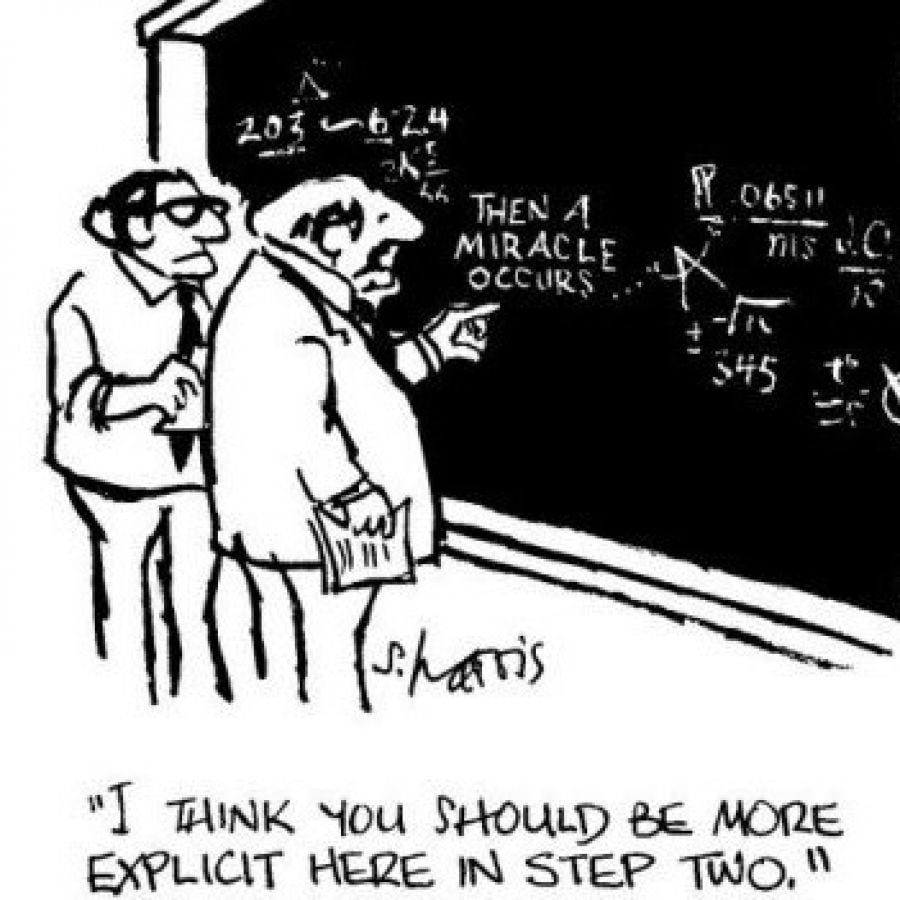
But difficult questions remain. And here the New Atheists’ argument collapses under its own weight.
The Bible itself highlights three moments of radical novelty where God intervenes to bring something entirely new into existence. It uses the Hebrew word bara (”create”) specifically for:
The universe itself (Genesis 1:1)
Animal life (Genesis 1:21)
Human beings, endowed with the neshama—the soul, the conscious “I” that interfaces the natural and supernatural (Genesis 1:27)
These align precisely with one known and two likely boundary problems in science. These aren’t “gaps” we lazily fill with “God did it.” They are philosophical and metaphysical realities where science reaches its limit. We infer the best explanation through reason, evidence, and the universe’s intelligible order.
Atheist scientists who grasped this discomfort often reached for alternatives. Years ago, as a grad student at UT-Austin, I attended a dinner featuring the late atheist Nobel laureate physicist Steven Weinberg as the speaker. He openly admitted that one motivation for the multiverse idea was to dethrone God as the only explanation for our universe’s beginning and its apparent fine-tuning.
Yet no one calls this a “multiverse of the gaps” even though that’s a perfect way to describe it. Why do we observe such precise constants in nature? Countless other universes! Why is gravity so weak? Ours is leaking gravity particles into other universes! It’s a catch-all that explains everything—and therefore nothing—while rendering our own existence meaningless.
Lennox and others have long pointed out that the New Atheists also misunderstood faith itself, redefining it as “believing where there’s no evidence.” In reality, faith is trust grounded in evidence, much like the trust we place in the rational intelligibility of the universe before we can even do science. As Einstein noted, genuine scientists operate with that kind of faith. Scientific laws describe what happens; they don’t breathe fire into the equations or cause the universe to exist.
The more I reflect on my own work in astrophysics, the more I see the same pattern Lennox describes: understanding doesn’t shrink God. It reveals the Artist more clearly.
It’s time to retire the “God of the gaps” smear once and for all. It’s not how thoughtful Christians think. The real question isn’t whether science will eventually explain everything without God. It’s whether the universe, in all its breathtaking order and intelligibility, makes more sense with or without a Creator who sustains the whole show.

If you enjoyed the article, I’d really appreciate it if you hit the like button below. It helps me see which topics resonate with readers and it boosts my writing. There’s also a share button if you’d like to send this to a friend who might enjoy the science-and-faith conversation.
If you’re a free subscriber and would like to support my work, please consider a paid subscription. Researching and writing these pieces takes time and effort, but I’m committed to keeping my best work—and the vast majority of my content—free for everyone. The generosity of my paid subscribers makes that possible.
“Gunning for God; Why the new atheists are missing the target” and, “Seven Days that divided the world (with a great index) both by John C Lennox. Gunning for God is worth the price for the notes alone. Isn’t it interesting that the (new) atheists debate and search to define a reality devoid of God. Their lives revolve around the proposition that “there is no God” which in essence means they function with a center of “not God”… a belief if you will in God - a god they must rid themselves of… cockeyed as it is, it is a religious system kept intact by study however abstract.
I thought of you while reading "Cosmic Chemistry" by Lennox.