


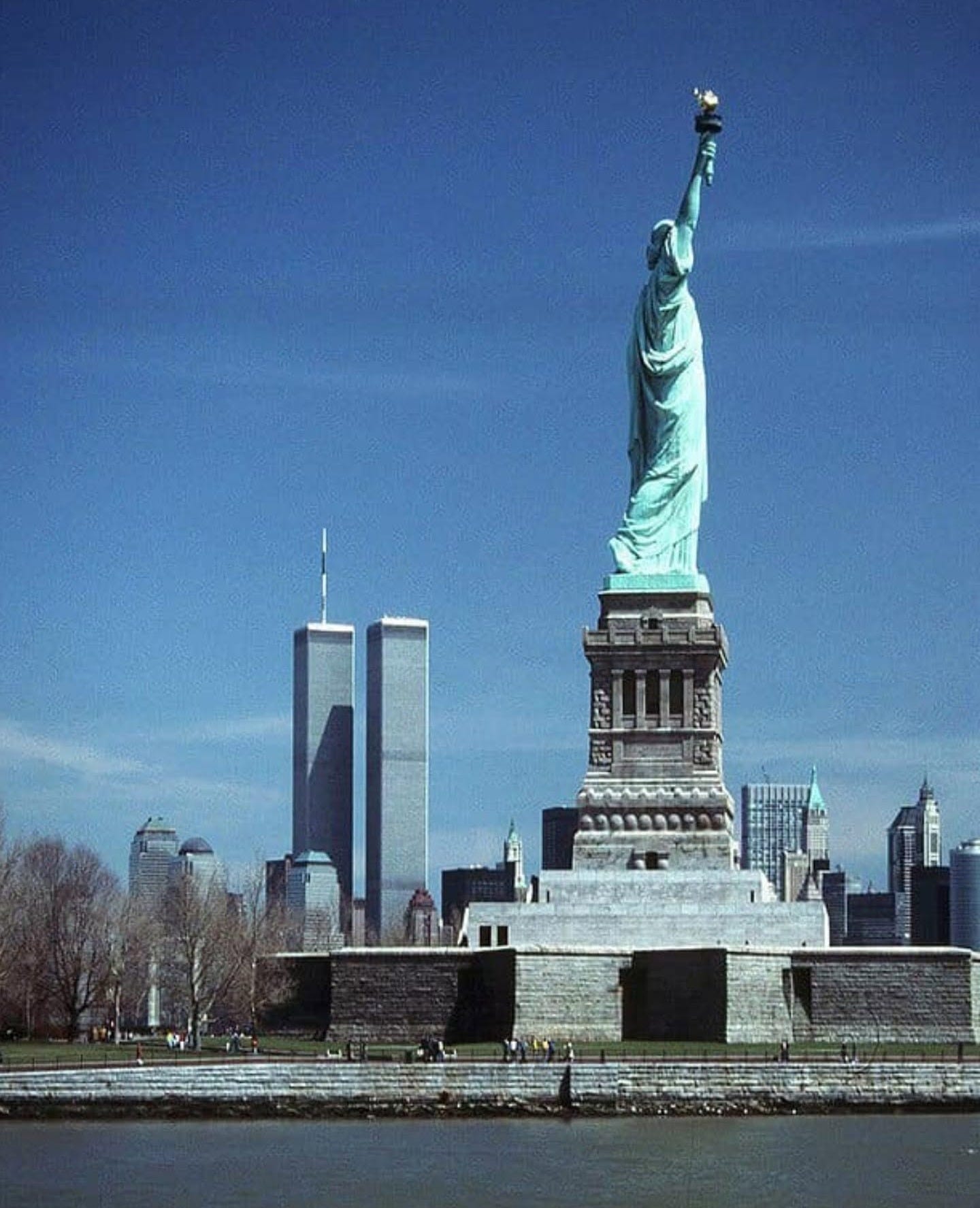
Memory is a peculiar thing. I have no idea what I was doing on September 10, 2001, but I vividly recall exactly where I was and what I was doing the morning of September 11, 2001.
I was a first-year astrophysics graduate student at the University of Texas at Austin. I’d fallen sick that morning—far too sick to go to work. Bent over, my head swimming, I reached for the landline from my air mattress in my tiny, unfurnished apartment to call in sick. The administrative assistant’s response puzzled me: “Someone has flown a plane into one of the World Trade Center buildings in New York, so I’m not sure anyone’s coming in today anyway.” I instantly pictured a small propeller plane carelessly crashing into the side of one of the towers. A few broken windows, maybe, with a wrecked two-seater and debris on the ground below. Why wouldn’t anyone come to work because of that? Not in a million years could I have imagined the reality.
I crawled to the other room and turned on the TV, searching for the news. Not a few broken windows and a mangled Cessna on the ground. Smoke billowing out of a gaping 767-shaped hole near the top of the north tower. Like so many other Americans that day, my mind couldn’t process the image. Everything else fell away and the world narrowed to what was happening in lower Manhattan at that moment. Then, live on TV, another Boeing 767 slammed into the south tower.
The mental video that plays in my head, to this day, is of the towers collapsing. Two hundred and twenty floors of concrete and steel pancaking down, even as rescue personnel raced into the buildings to save their occupants. Stunned New Yorkers, frozen on the streets, their minds struggling to process the horror before them, slowly realizing they needed to flee from the massive clouds of dust and debris hurtling toward them.
That morning I watched two towers fall. In the years that followed I watched a different kind of collapse—the attempt to pull the Christian foundation out from under the civilization that had produced both the science I was studying and the country I lived in.
It would be an understatement to say that much changed after that day. American geopolitics was turned on its head. Wars began. Travel on any kind of public transportation felt like a gamble. Many feared this was just the beginning of a new America beset by international terror. And like a bitter phoenix, the New Atheist movement rose from the ashes of that horrible time. Seeking to blame religion in general for 9/11 and nearly every societal ill of civilization before and after, the Four Horsemen of the New Atheist movement—Sam Harris, Daniel Dennett, Christopher Hitchens, and Richard Dawkins—thundered into the public sphere.
I was no longer an atheist in 2001. I’d become a theist the summer of 1999, but I wasn’t yet Christian. It’s been so long, it’s now difficult to recall the moment I seriously began to consider religion. Gerald Schroeder’s book, The Science of God, randomly spotted on a shelf in an Austin bookstore, ignited my interest. I began to explore the book’s premises, opening a Bible for the first time in my life to test its claims. A few years later, I emerged from that experience utterly convinced, not only that God was real, but that the Bible faithfully chronicled His deeds and relationship with us. In 2006, the same year Richard Dawkins published his landmark book, The God Delusion, I accepted Jesus Christ as my Lord and Savior.
This was before smartphones, social media, and wi-fi. Most people still had landlines, and only about half of American homes had access to the internet in the early 2000s. In the online world, blogs were king, and that’s where I spent much of my free time. Fresh with the zeal of my conversion, I hit the blogosphere ready to debate religion and atheism, especially as it related to science, naively expecting good-faith discussions about the evidence. Instead, I found myself in a realm saturated by the arrogance, over-confidence, and self-importance of the New Atheist movement. In the place of evidence, I read Sam Harris’ vacuous slogans. Rather than arguments, I was glove-slapped with Hitchens’ empty witticisms. It was tedious and annoying.
A year after my conversion, my grad student book club chose The God Delusion as our book of the month. Dawkins, the natural scientist, the author of The Selfish Gene, the unofficial king of the New Atheist movement—finally, a worthy opponent, I thought. Expecting substance, carefully-weighed evidence, and challenging arguments, what I got was boring, empty polemics. Chapter titles were promising, but one after another, they failed to deliver. Chapter 4 was the low point. Titled “Why There Almost Certainly Is No God,” it slid from discussing the appearance of design into complaints about what jerks Christians are. Utter disappointment. I felt like a fresh, young boxer finally getting to spar with one of the greats, only to find he was now all flash and no substance.
I couldn’t believe a scientist of this caliber would begin his “analysis” by carelessly lumping the great religions of the world into one “faith” group. Here was a world-renowned biologist, a person who has demonstrated care in distinguishing between things that look similar on the surface but are not the same, doing precisely the opposite. In The Genetic Book of the Dead Dawkins highlighted the example of the pill woodlouse and the pill millipede: when they roll into a ball they look almost identical. Yet one is a crustacean and the other is a myriapod. Despite their similar appearance, they have completely different body plans, ancestry, and biology. Dawkins took pains to distinguish between these tiny creatures, yet he looked at the great religions of the world and decided it was fine to dump them all into the same category.
On that basis—armed with empty mottos, bad-faith talking points, specious arguments, and cherry-picked data, and propelled by the emotional fallout of one of the worst days in American history—the New Atheists sought to change the religious landscape of the West. Their aim: to remove the foundation of our civilization that was built over long centuries. They imagined a fairytale result but had no real idea of the actual consequences. Daniel Dennett and Christopher Hitchens passed away years ago and their influence largely passed with them. Sam Harris moved the fight onto different ground—meditation, his Making Sense podcast, and the culture war over Islamism and the American left. On the twenty-fifth anniversary of 9/11 he was still talking about the second plane and his book, The End of Faith. Richard Dawkins remains but he has, in an odd sense, evolved. In 2024 he called himself a “cultural Christian” and said Christianity is a “fundamentally decent religion” in a way he does not think Islam is. When asked whether the New Atheists had thought about what would replace the faith they attacked, he answered simply: “No.” He still thinks Christianity’s doctrines are nonsense, but he has noticed—rather late—that he prefers the civilization those doctrines built over the alternatives.
Ironically, The God Delusion ended up supporting my faith. Maybe Dawkins would be appalled by this, but it’s the truth. I hadn’t realized it for most of my young life, but as an atheist, my worldview was built on a weak foundation. When I first noticed the cracks as a university student, I found little comfort from the atheist intellectuals I knew of at the time. Richard Dawkins became the reigning king in the early 2000s, and as a new Christian, I intended to look back at his body of work, not for support, but to see if my newfound faith could withstand the challenge. Reading The God Delusion was disappointing—it offered very little challenge—but it was an eye-opening experience to realize the New Atheist Goliath was really just a lumbering weakling in shiny armor.
Twenty-five years later, the dust has settled, and Dawkins’ scientific sloppiness looks even worse in hindsight. A biologist who took great care in his own scientific field was willing to treat the faith that built the universities, the hospitals, and the moral vocabulary of the West as interchangeable with the ideology that flew airliners full of people into the twin towers. The New Atheists wanted a world without religion. They helped get us part-way there: religious “nones” are now the fastest-growing religious group in the U.S., but the needle hasn’t moved on atheism—its numbers remain more or less unchanged. What they helped produce was a confused world that still has religion, but is losing its ability to value evidence and reasoned arguments, has no idea what constitutes individual dignity, and struggles to define purpose and meaning in life.
Twenty years ago, I became Christian, not in spite of the evidence, but because of it. The universe I was studying looked much more like the result of a Word deliberately spoken than a blind cosmic accident. I found the historical evidence for the divinity of Jesus Christ virtually unassailable. A civilization built on the ideals and assumptions of Christianity was more appealing to me than any other. The message of Dawkins and the other New Atheists has been highly destructive on a societal level, but in my own life it has accomplished something useful. It showed me that the loudest case against God was not a carefully-weighed argument from otherwise meticulous intellectuals. It was a reaction—understandable, human, but still a reaction—to the horrific sight of burning buildings and falling steel.
Memory is peculiar. I can’t tell you what I was doing the morning of September 10, 2001. I can tell you exactly where I was twenty-four hours later. And I can tell you what I found when I finally opened the book that was supposed to finish religion for good. The twin towers fell. The arguments for God, for Jesus Christ, and for the foundation of our civilization, when I examined them, did not.
***
Related, and worth the read:
In Memoriam: Twenty-five Years: A vivid, harrowing, and ultimately touching reflection on what it was like to live in New York City during and following the events of 9/11. By my friend, PhD biochemist and atheist-turned-Christian, Sy Garte.

Note: My workload has doubled this semester, so I’ve been less present on Notes, X, and in the comments. I’m hoping that, once I get the swing of this new schedule, I’ll be more involved.
If you enjoyed the article, I’d really appreciate it if you hit the like button below. It helps me see which topics resonate with readers and it boosts my writing. There’s also a share button if you’d like to send this to a friend who might enjoy the science-and-faith conversation.
Please also feel free to comment or ask questions below. If you’re new here, I encourage you to check out my FAQ first.
If you’re a free subscriber and would like to support my work, please consider a paid subscription. Researching and writing these pieces takes time and effort, but I’m committed to keeping my content free for everyone. The generosity of my paid subscribers makes that possible.
Sarah, this is powerful. What struck me most is the way you trace two collapses—one physical and immediate, the other cultural and slow-moving. The towers fell in a morning; the attempt to pull Christianity out from under the West has taken decades. But your story exposes something the New Atheists never accounted for: you can tear down symbols, but you cannot dismantle a foundation that God Himself laid.
The irony you highlight is profound. The loudest critics of Christianity assumed that removing faith would reveal a sturdier, more rational world. Instead, it revealed how much of our moral vocabulary, our sense of dignity, and even our scientific confidence rested on truths they never bothered to examine. When the dust settled, their arguments looked less like careful reasoning and more like the emotional recoil of a civilization in shock.
Your testimony reminds us that the Gospel doesn’t crumble under scrutiny. It holds. It explains. It illuminates. And it continues to draw people—not through slogans or polemics, but through the sheer solidity of a God who speaks, acts, and anchors reality.
Thank you for telling this story with honesty and courage. In an age still wrestling with the fallout of that cultural collapse, voices like yours help people see that what fell that day was not the foundation. Christ remains.
Great narrative of your experience! I see the failure of significant national debate and discussion of God, Christianity, relating it to our American founding, as well as logical and reasonable, and yes, thinking populist expressions of truth concerning faith, reality, and human existence. That is a spiritual battle I know, not just investigative or literary, and I believe it must be wisely pressed in every way possible. Thanks for sharing.