


As an astrophysicist who’s spent years digging into the physics of the universe, I keep running into the same stubborn fact: the more I’ve learned, the harder it’s been to believe all of this is an accident. In fact, this is why I dropped my lifelong atheism in university and never looked back.
So, let’s talk about what I consider to be the five most compelling science-based reasons to believe in God.
Teleology — A fancy word for “the universe looks designed.” When I was an undergrad studying data for the Big Bang, everything I needed to answer my specific question—what was the chemistry of the very early universe before stars started cooking up heavier elements?—was conveniently in place. Too conveniently. A foolproof way to fingerprint every element and compound? Check. A smooth, powerful light source to backlight the most distant reaches? Check. An expanding universe that lets us rewind cosmic history just by looking at different wavelengths? Check. A transparent atmosphere so we can actually do the observations from the ground? Check. Laws of nature that don’t randomly change with time or place? Check. The list goes on. I literally could not have done the work unless dozens of these parameters lined up just right. It felt less like luck and more like an engraved invitation to explore the careful work of a transcendent Intelligence.
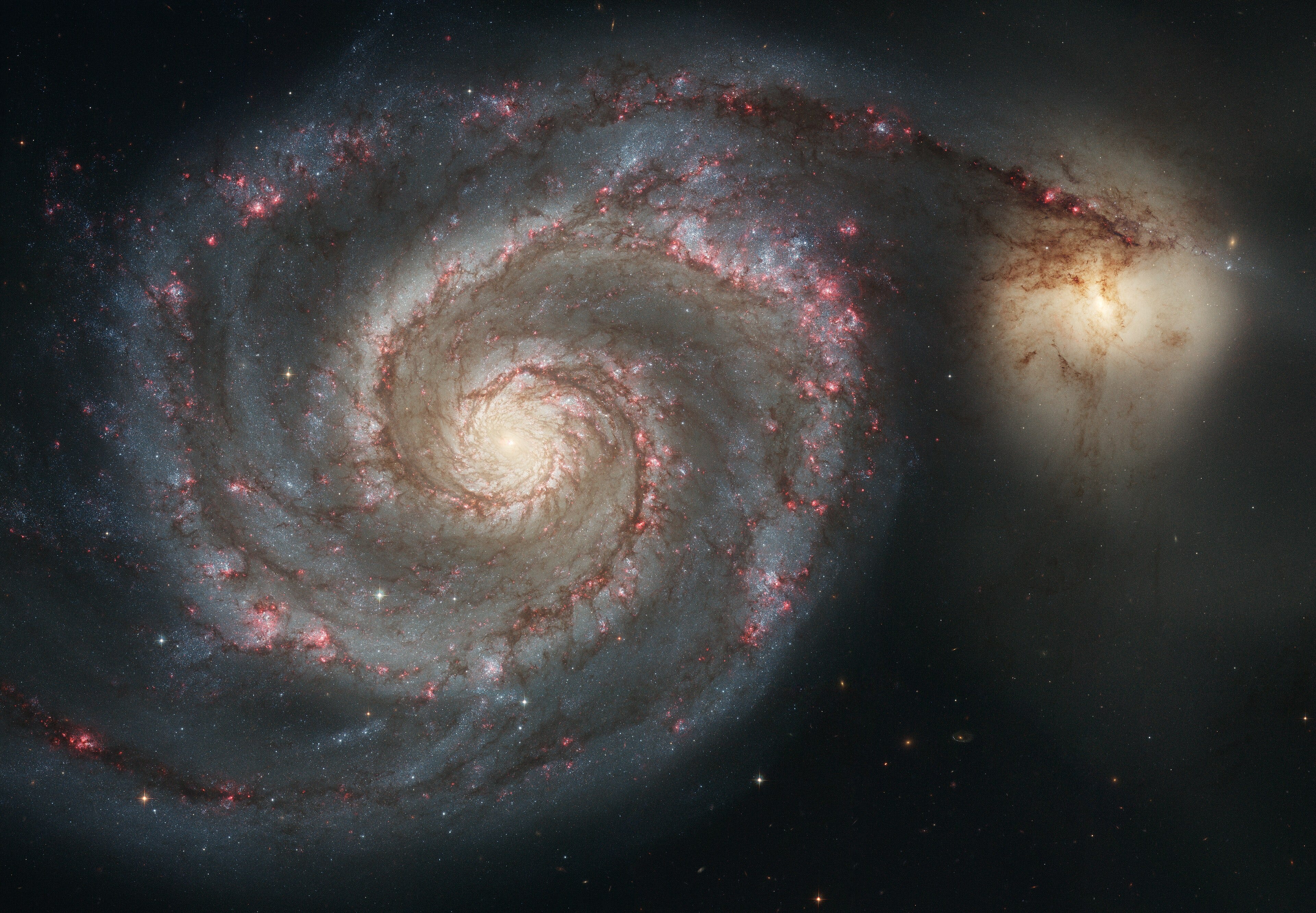
Beauty — The universe is flat-out stunning, and almost everyone agrees. In all my years I’ve met exactly one person who didn’t get excited over astronomical images, and that person was just a joyless oddball. We lose ourselves in shots of the Orion Molecular Cloud. We swoon over images of the Whirlpool Galaxy. Ancient people looked up at a sky thick with thousands of stars and decided it must be the home of the gods. But none of that beauty is required for our survival. It doesn’t give us any obvious evolutionary edge. It doesn’t even make us better people (well… maybe a little). Yet the cosmos is luxuriously, extravagantly, eye-poppingly beautiful. Even the math underlying the workings of the universe is beautiful. The only explanation that makes sense to me is that it’s the handiwork of a God who is even more luxuriously, extravagantly, eye-poppingly beautiful.
Fine-tuning — The fundamental constants and initial conditions of the universe—the strength of gravity, the electromagnetic force, the expansion rate right after the Big Bang—are dialed in to an absurdly narrow “Goldilocks” range. Nudge any of them even a tiny fraction and you don’t get atoms, stars, galaxies, or even a single living cell. The precision is so extreme that calling it “lucky” feels like a ridiculous cop-out. To me it looks intentional.
Enormity — Buckle up—this one gets weird. According to thermodynamics and quantum mechanics, it is overwhelmingly more probable that you are a single brain that just fluctuated into existence a second ago, complete with fake memories of this conversation, than that the entire 93-billion-light-year observable universe (with its galaxies, planets, and 10^30 living creatures on Earth alone) actually exists. That’s the Boltzmann Brain paradox. It’s not strictly impossible for the real universe to be here… but the odds are so lopsided that the most rational way to believe the universe we see is real (instead of your lonely brain hallucinating everything) is to say a God willed it into existence and keeps sustaining it.
Existence — Even a Boltzmann Brain needs an explanation. How would it begin to exist? How does anything begin to exist? The only things that don’t require an outside cause are (a) nothing, or (b) something that’s eternally self-existing. The Kalam Cosmological Argument puts it simply: everything else— that is, anything that begins to exist—has a cause. The universe began to exist, therefore it has a cause. That cause can’t be the universe itself, so it has to be something beyond, and something with agency (the ability to affect change) and will (the ability to consciously choose to affect change). And you can’t solve the problem by kicking the can down an infinite road of causes; eventually you need something eternal and self-existing. Sounds like God to me.
And there you have it, my top-5 science-based reasons for belief in God. These arguments don’t “prove” God exists in some scientific theory sense, but personally I’m convinced by any one of them—and the combined weight of all of them is impossible to ignore. These are the reasons I went from atheism to belief in God as a physics student, and why I continue to be confident in my beliefs.
If you made it this far—thank you!—and liked this article, do me a favor and hit the like button below. This helps me understand which topics resonate with my readers and it boosts my writing. There’s also a share button if you want to send it to a friend who’d enjoy the science-and-faith conversation. If you’re a free subscriber who would like to support my work, you can upgrade to a paid subscription.
A great summary, I would add math to the list because as Wigner and Einstein both commented, the real mystery is how the world can be comprehensible.
This is my favorite sentence from your essay:
The only explanation that makes sense to me is that it’s the handiwork of a God who is even more luxuriously, extravagantly, eye-poppingly beautiful.