


When I was a young physics student shaking off the atheism I’d been raised with, one argument hit me like a revelation: the fine-tuning of the universe for life. The fundamental parameters of our cosmos—the mass of the electron, the strength of gravity, the cosmological constant—are dialed in with such exquisite precision that the most reasonable explanation is intentional design.
Astrophysicist Luke Barnes, one of the leading experts on this topic, points out that the Standard Models of particle physics and cosmology involve 31 fundamental constants and initial conditions. These aren’t derived from deeper equations; they’re free parameters we measure but can’t predict. Imagine a universe-generating machine with 31 dials, each capable of being set across a vast range of values. In our universe, they’re all turned to exactly the right settings to permit complex chemistry, stars, planets, and life.
Here are just a few striking examples:
The cosmological constant (Λ): This controls the universe’s expansion rate. If it were larger by even a tiny fraction—roughly one part in 10¹²⁰—the universe would have expanded too rapidly for galaxies to form. Too small, and it might have re-collapsed long ago.
The strength of gravity relative to the other forces: A slight increase, and stars would burn out too quickly or collapse into black holes. A slight decrease, and no stars or heavy elements would form at all.
The masses of the up and down quarks: Tweaking these by small factors (e.g., increasing the down quark mass by a factor of ~3) would leave us with a universe of nothing but hydrogen—or worse, a sterile neutron-dominated cosmos with no chemistry possible.
The electromagnetic force and nuclear forces: Their delicate balance allows stable atoms, long-lived stars, and the fusion processes that create the elements essential for life.
Barnes and others have shown that even modest changes in these (and many of the other parameters) don’t produce exotic universes teeming with alternative forms of life. Instead, they yield dead, boring, or violently inhospitable places: no atoms, no stars, no chemistry—nothing that could support any conceivable complexity.
We can picture those 31 dials. Turn even one just a hair off, and our life-permitting universe vanishes.
So how do we explain this astonishing precision? There are three main possibilities:
Chance
Necessity
Design
Chance says the universe could have had any configuration, but it just happened to hit this one. According to calculations within our current physics, the odds of randomly landing in the life-permitting range for these parameters are staggeringly low—on the order of 1 in 10¹³⁶ or worse for the combined “little question” of fine-tuning under our known laws. Physicists despise coincidences this monumental. No serious scientist shrugs and says, “We just got insanely lucky.” It’s not an explanation; it’s an evasion.
Necessity claims the laws of physics require these exact values—there was never any other option. But this doesn’t hold up. Nothing in the equations of the Standard Model or general relativity dictates the specific numerical values of these constants. They’re plugged in by hand; the theories work perfectly well with different numbers. As physicist Richard Feynman famously noted about the fine-structure constant (one of the force couplings), it’s a “magic number” with no deeper explanation from the laws themselves. If necessity were true, we’d expect a theory that derives these values uniquely. We don’t have one. Changing the dials doesn’t break the logical consistency of the laws—it just breaks the possibility of life.
That leaves design. Some Mind or Agent intentionally set the knobs to create a universe capable of supporting life. It’s the most straightforward, non-coincidental explanation.
Atheists often push back hard against this. When I posted about fine-tuning on X recently, the replies poured in—including some classics.
One common objection: “Of course the universe is finely tuned—if it wasn’t, we wouldn’t be here to observe it.”
This is the anthropic principle as a supposed defeater. It sounds clever, but it’s just a truism, not an explanation. Christian philosopher William Lane Craig illustrates why with a vivid analogy: Imagine standing before a firing squad of 50–100 expert marksmen, all aiming straight at your heart. They fire simultaneously. You open your eyes and realize you’re completely unharmed. Would you shrug and say, “Well, if they hadn’t missed, I wouldn’t be here to notice”? Of course not. The extreme improbability cries out for an explanation—perhaps the marksmen missed on purpose. The same applies here: the fact that we can only observe a life-permitting universe doesn’t make its existence any less surprising or in need of accounting.
Another reply I’ve heard twice now (it must be making the rounds): “Posting God as the explanation is epistemologically expensive.” In other words, invoking a complex, unproven God burdens us with too many assumptions compared to “simpler” naturalistic alternatives.
Fair enough—but what are those simpler alternatives? A multiverse where an infinite number of universes bubble up with random parameters, so we inevitably find ourselves in one of the rare life-permitting ones? Or the universe magically popping into existence from nothing, already perfectly tuned?
The multiverse sounds scientific, but Craig has leveled strong objections. An actual infinite multiverse leads to bizarre paradoxes (like the Boltzmann brain problem, where random fluctuations would produce isolated observers more often than ordered universes). It often requires even greater fine-tuning of the multiverse-generating mechanism itself. And it lacks independent evidence—it’s speculative, not predictive in a testable way. Positing unobservable infinities to avoid design more like special pleading and less like parsimony.
As for universes “popping into existence from nothing” with the right parameters… that’s not simpler than design. It’s magic dressed up in quantum jargon. If you reject God for seeming too “magical,” you can’t consistently embrace something far more ad hoc.
In his debate with Craig, theoretical physicist Sean Carroll suggested that a universe with very different parameters might still support some wildly different form of life—something we can’t even imagine. It was an intriguing thought. But Barnes has shown the problem: small tweaks to the dials don’t yield complex, interesting alternative universes. They produce sterile voids, featureless hydrogen soups, or rapid collapses where nothing enduring or complex can arise. Life of any kind—carbon-based, silicon-based, or exotic—requires stable complexity, and that narrow window is what’s astonishingly rare.
We’re left with the fine-tuning problem. Those who reject design keep searching for workarounds. But as a Christian, I’m not stuck. I see the universe as the work of a purposeful Creator—the same God in whom many of history’s greatest scientists believed. He crafted a cosmos with ends in mind, including (at minimum) a place where human beings could exist, where He could enter His creation in the person of Jesus Christ, and where an act of unimaginable love and sacrifice could reconcile us to Himself.
This explanation is not only elegant and parsimonious; it resonates deeply with the wonder I feel when I study physics. It’s why I left behind the atheism of my youth and devoted my life to following Jesus. The fine-tuning isn’t just interesting data to me, it’s a cosmic signpost pointing to the One who set the dials with care.
If you’re exploring these ideas and not yet convinced, I encourage you to dig deeper. Start with Luke Barnes’ papers on ADS and his excellent book with Geraint Lewis, A Fortunate Universe. The evidence is there, waiting to challenge your assumptions the way it once challenged mine.
If you enjoyed this piece on the fine-tuning of the universe, I have some great news to share.
I was honored to be interviewed for The Story of Everything, a stunning new documentary that explores the biggest questions in science: Where did the universe come from? Why is it so precisely calibrated for life? And what does the evidence from cosmology, physics, and biology really point to?
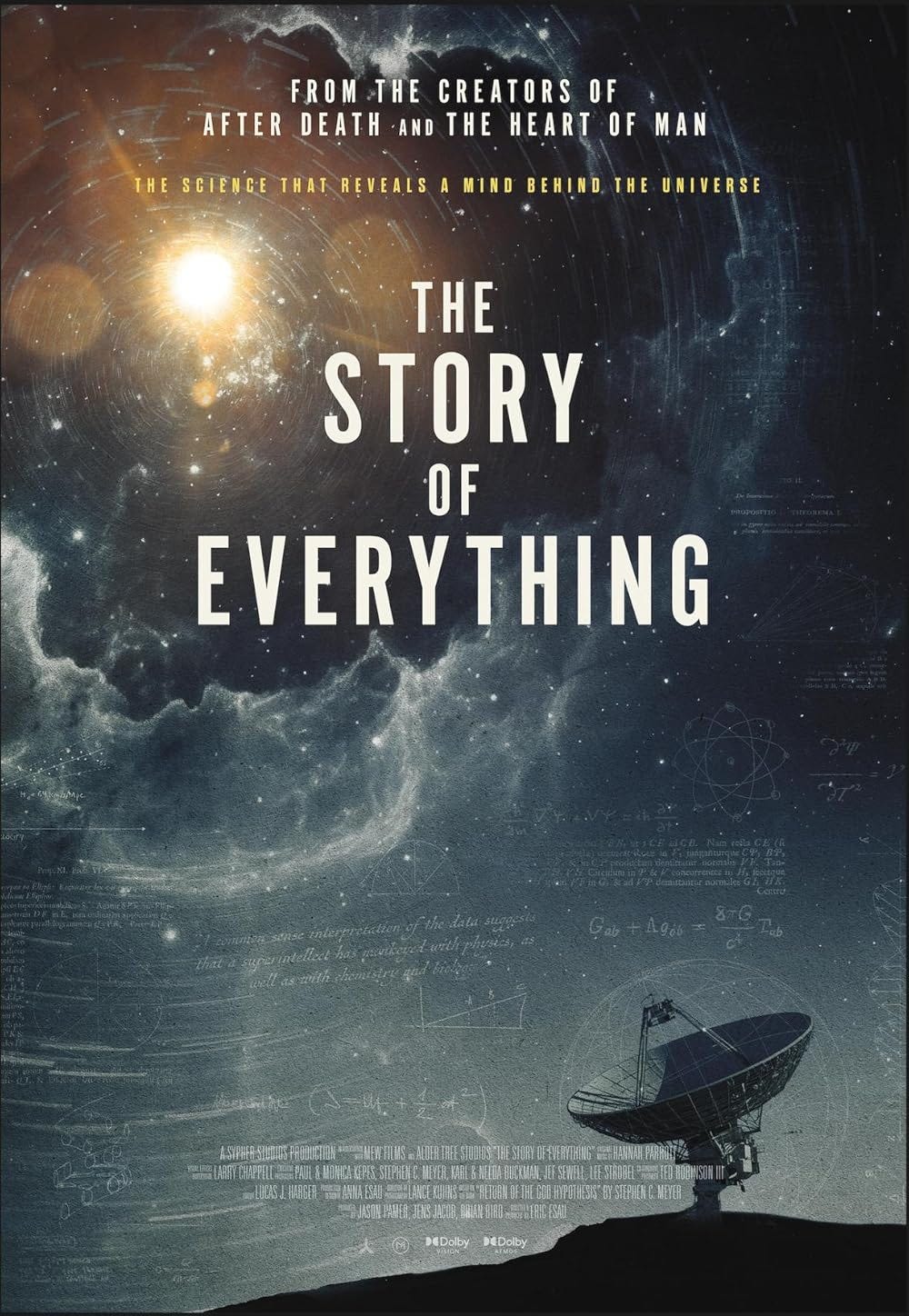
The film takes viewers on a cinematic journey through the cosmos and the intricacies of life, revealing the consistent signature of intentional design woven throughout nature—from the fundamental constants that make stars and galaxies possible to the elegant complexity inside every living cell. It features leading voices in science and philosophy, including Stephen C. Meyer, John Lennox, and others, and makes a compelling case that the universe isn’t an accident.
I appear in the film sharing my perspective as an astrophysicist—how the exquisite fine-tuning of the cosmos convinced me that our universe was crafted with purpose, and ultimately led me from atheism to faith in Christ.
The Story of Everything opens in theaters nationwide on April 30, 2026, with showings through May 6. It’s the kind of film that will hopefully inspire thoughtful conversations about science, origins, and meaning—perfect for believers and skeptics alike.
You can find tickets and more information at thestoryofeverything.film or at Fathom Entertainment.
If you made it this far—thank you—and liked my article, do me a favor and hit the like button below. This helps me understand which topics resonate with my readers, and it boosts my writing. There’s also a share button if you want to send it to a friend who’d enjoy the science-and-faith conversation. If you’re a free subscriber who would like to support my work, please consider upgrading to a paid subscription.
This was great. What irony that a speculative multiverse is treated as simpler than a personal Creator, even though it is arguably the more metaphysically expensive claim.
Also, Angel Studios just released 'Universe Designed'. It features all my favorite scientists and Christian Apologists. It can be rented.