Sunday Superposition #44
Why I Had to Write My Book, No More Leap Seconds, The Last Laugh

The last Sunday of each month features Sunday Superposition, a collection of personal thoughts, interesting science news, and something funny. It’s truly one of my favorite things to create. As a special thank you to my paid subscribers, whose generosity helps keep me writing, they get first access. This article will open to everyone on November 1st.
Why I Had to Write My Book
I had originally planned to write a scientific apologetic as my first book. This was my life’s work, and I’d planned it for years. But the last several years just wore me down. Multiple rounds of cancer, the long stretch of covid lockdowns and forced isolation, all the political craziness of the last several years, the slow erosion of a shared American culture, and strained personal relationships all took their toll. Somewhere along the way, the desire to finish that book simply evaporated.
A few years ago, a close friend gave me Ruth Chou Simons’ Beholding and Becoming. In it she places her gorgeous watercolor paintings of the natural world alongside short reflections on how we become what we behold. Reading through those lush pages, I realized this book was telling my story. My own life had been shaped by beholding the heavens from the time I was a child in remote northern British Columbia, lying on my back under a dark sky and wondering at its vastness. That early love of space propelled me through school and into university physics and math, then into a summer research program at UCSD’s Center for Astrophysics and Space Sciences. There I studied the early universe and found God’s fingerprints all over the cosmos I already loved.
What followed were years of searching for the true identity of that God until I finally came to rest at the foot of the cross. I eagerly shared the reasons and evidence that led me there with anyone who would listen. I had managed to gather 50,000 followers on social media who were interested in my message, many of them asking when I was going to write a book. It was in the works when every thread in the fabric of my life seemed to unravel.
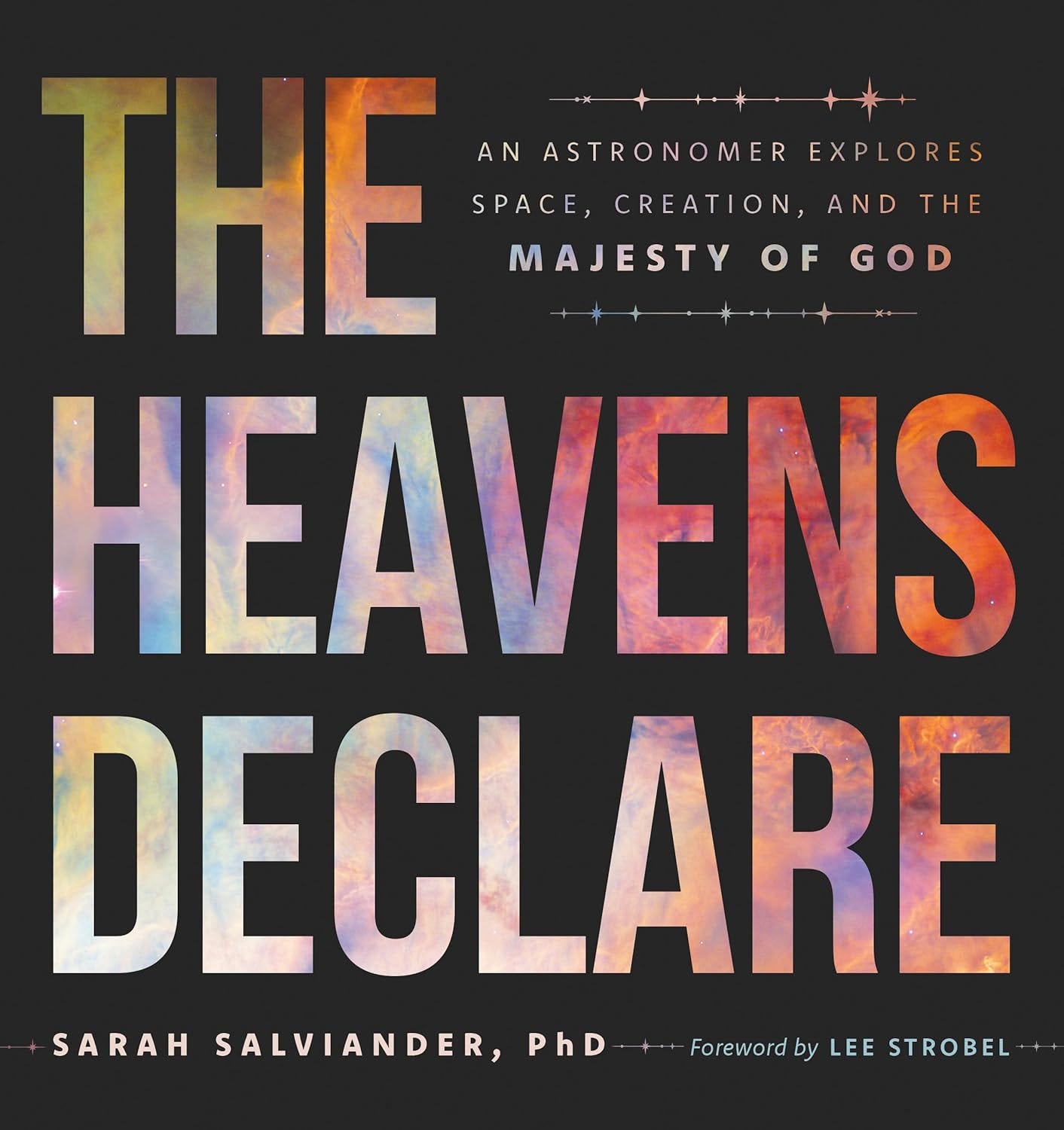
In that fragile season, I abandoned that book. I began to wonder whether I might write something closer to Simons’ devotional. I wanted to pair beautiful images with reflections on God, the human condition, and His relationship with us. Only instead of my own artwork, the artwork would be His—gorgeous images of the heavens that declare His glory. That’s how The Heavens Declare began.
Throughout the writing process, I’ve come to think there needs to be more of this personal, relational, even emotional register in Christian apologetics, especially from scientists. I came to belief in God almost entirely through reasoned arguments and evidence. Years later, when I was finally baptized, I quietly worried that my conversion had been all “head” and no “heart.” Twenty years on, I see that the heart is as necessary as the head when we actually relate to God and Jesus Christ. For me, a lot of that heart-relating is through nature. He made the universe a feast for the eyes, and I still feel an incredible thrill when I look at detailed images of colorful planets and nebulae, vast star fields, and the colossal winding arms of galaxies.
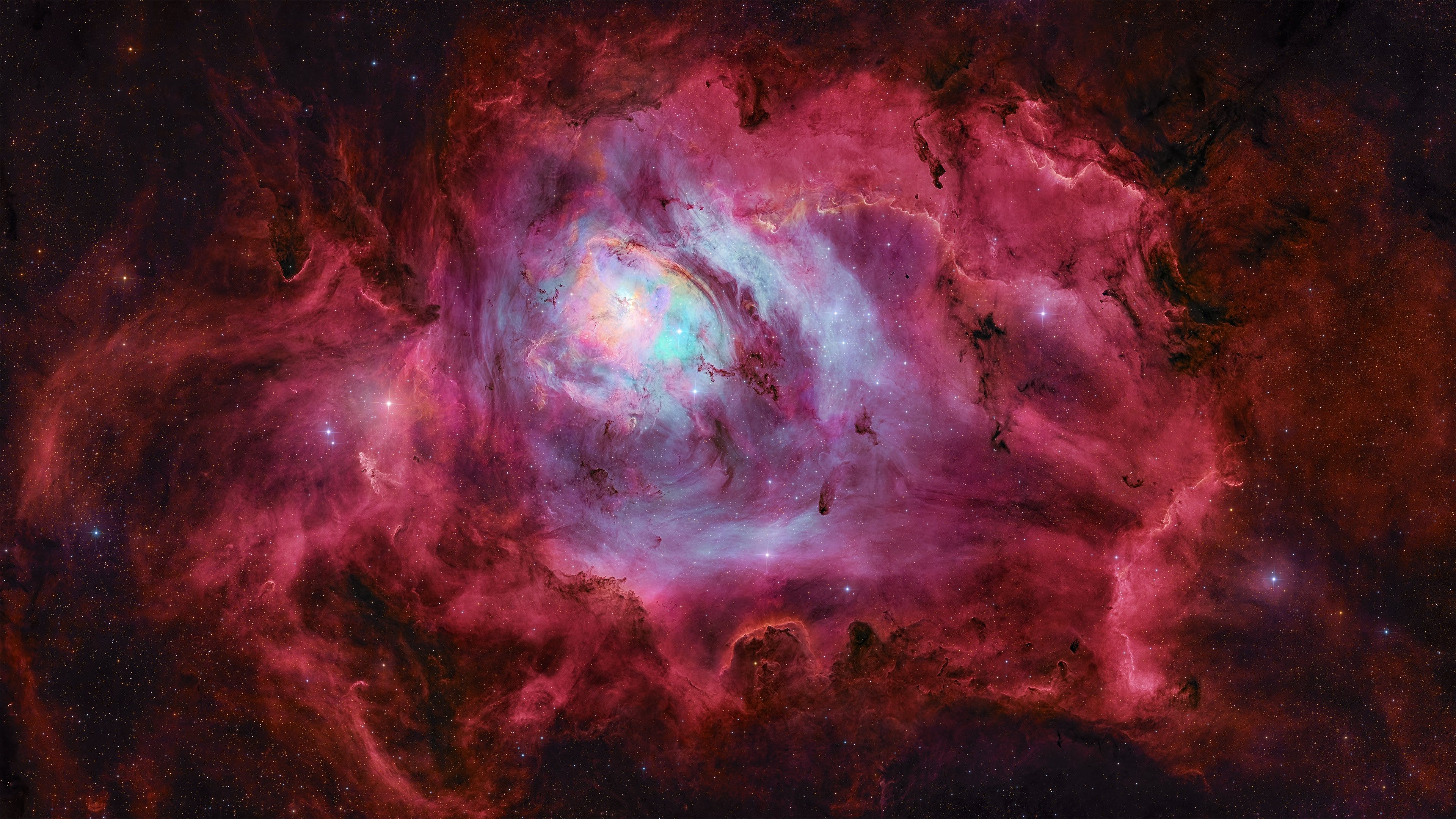
The other day I zoomed in on an image of the Trifid Nebula taken by the astrophotographer Andrew McCarthy. It smote my heart. Moments like that remind me how unfathomably immense and powerful God is. They remind me that God is an artist who loves beauty. And that same God humbled Himself to take human form, to see the world He created through human eyes, and to experience the ordinary inconveniences, pains, trials, and heartbreaks we know with His perfect and grieving heart. For me, the clearest alpha-to-omega picture of Him is the Gospel of John: it opens with the Word speaking the entire universe into existence and closes with Jesus casually grilling fish on a beach for His friends.
I tried to catch some of that essence in my book. In this season of life I needed to relate to Him that way. I already had the “head” material. At this point, there is frankly nothing that could even plausibly convince me God doesn’t exist. But other questions still surface from time to time. Does He love us? Does He notice all the injustice in the world? Does He care about our pain? How can such an immense and powerful Being love these small dust creatures crawling around on an infinitesimal rock drifting through the void of space?
Writing the book brought the reassurance back to me, freshly. The answer is yes. He loves us. He notices injustice. He cares about our pain. And because He is perfect—because He is love itself—His infinite heart is large enough to encompass the entire universe He created and everyone in it.
The scientific apologetics book is still coming. Those questions matter, especially now. But for me, the heart book had to come first. If you’d like a copy of my book (releasing November 3rd), you can pre-order The Heavens Declare here.
Foundations for Faith
The heavens declare the glory of God; the skies proclaim the work of his hands. —Psalm 19:1
When I consider your heavens, the work of your fingers, the moon and the stars, which you have set in place, what is mankind that you are mindful of them, human beings that you care for them? —Psalm 8:3–4
In the beginning was the Word, and the Word was with God, and the Word was God… The Word became flesh and made his dwelling among us. —John 1:1, 14
And we all, who with unveiled faces contemplate the Lord’s glory, are being transformed into his image with ever-increasing glory. —2 Corinthians 3:18
Featured Science News
My favorite science news story of the month
Scientists have voted to abolish the leap second
[New Scientist Magazine]
This isn’t Earth-shattering news, but it touches on something most of us rarely think about: how we actually keep track of time. Since 1972, scientists have added a “leap second” to every year to keep atomic clocks synchronized with Earth’s rotation (usually on June 30th or December 31st, Universal Time). But at a recent meeting in Versailles, representatives from dozens of countries decided to stop this practice. Starting May 20, 2027, Coordinated Universal Time will be allowed to drift up to a full hour away from astronomical time before anyone corrects it. The reason is practical: modern systems, like stock markets, telecom networks, GPS, airline bookings, and so on, have grown brittle around the occasional one-second insertion, and a negative leap second—now a real possibility because Earth’s spin is mysteriously speeding up slightly—would be even messier to deal with.
For most of us the change won’t even be noticeable. Astronomers and navigators will still track Earth’s true rotation with high precision while everyone else lives with a slowly growing gap between clock time and solar time. Does that matter? Not really, as it will take centuries for that gap to widen to one hour.
The same meeting also called for proposals on a new definition of the second. The current definition depends on the frequency of radiation from cesium, but now with highly precise optical clocks, scientists are seeking a new definition. This is especially important as a shared time standard will be needed once humans permanently inhabit the Moon.
The Last Laugh
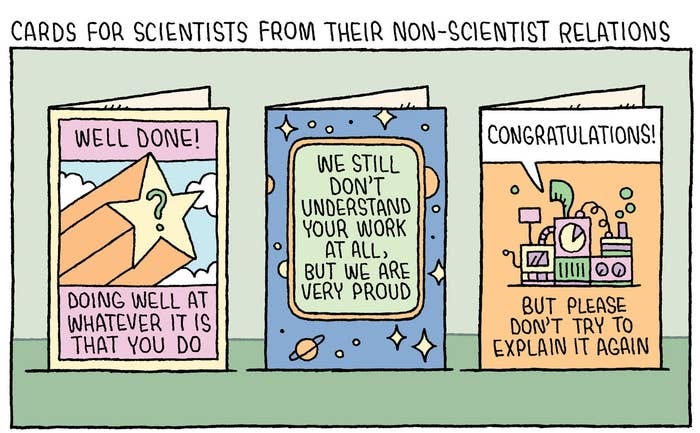
These are exactly the cards my mom would’ve sent me when I was in grad school. From Department of Mind-Blowing Theories by Tom Gauld.

What’s a superposition?
It’s the quantum phenomenon in which a system exists as a combination of multiple possible states at the same time. Confusingly, it’s neither a simple “AND” (both happening together) or a classical “OR” (one or the other). Quantum superposition is a deeper, inherently ambiguous kind of possibility that produces effects no ordinary uncertainty can explain—that is, until a measurement “collapses” the system into a single outcome.
In the human world, we also exist as a combination of multiple possible states at the same time—faith and doubt, joy and struggle, wholeness and brokenness, the sacred and the ridiculous—all in perpetual superposition, until it gets collapsed into one reality in eternity.
If you enjoyed the article, I’d appreciate it if you click the like button below. It helps me see which topics resonate with readers and it boosts my articles. There’s also a share button if you’d like to send this to a friend who might enjoy the science-and-faith conversation.
Please also feel free to comment or ask questions below. If you’re new here, I encourage you to check out my FAQ first.
"I had originally planned to write a scientific apologetic as my first book. This was my life’s work, and I’d planned it for years. But the last several years just wore me down. Multiple rounds of cancer, the long stretch of covid lockdowns and forced isolation, all the political craziness of the last several years, the slow erosion of a shared American culture, and strained personal relationships all took their toll. Somewhere along the way, the desire to finish that book simply evaporated."
Sounds familiar. Congrats on finishing and publishing your book. Looking forward to its November 4th arrival. Too early for "Merry Christmas"?
I've preordered two copies, one for me and one for a friend. He is not only a cross-cultural evangelism trainer, but also an apologetics expert who "specializes" in helping people move from general revelation to special revelation. So your book should be beneficial to him. Thanks for your efforts even though the hard times. God bless.