


The last Sunday of each month features Sunday Superposition, a collection of personal thoughts and stories, science news that catches my eye, and something worthy of a chuckle. It’s truly one of my favorite things to create. As a special thank you to my paid subscribers, whose generosity helps keep me writing and ensures my content remains free, they get first access. This article will open to everyone on October 4th.
Mercy and the Hero
I talk a lot about fiction (movies and books) here. Mainly that’s for two reasons. One, I love immersing myself in a fictional world, and there are some great ones in the Western canon. But I mostly talk about them because stories are a powerful way to transmit and reinforce cultural values. If you ever wondered why Jesus often spoke in parables, that’s one reason.
I keep coming back to two stories in my articles here—The Lord of the Rings and the original Star Wars—partly because they resonate with me on a personal level. And in a subtle but deeply Christian way, they also positively subvert expectations—in this case, by refusing to let their heroes win by their own strength.
Over centuries, Christian civilization has built up an incredible catalog of cultural entertainment: Dante and Milton, Bunyan’s Pilgrim’s Progress, Bach and Handel, Dostoevsky, and on down to J.R.R. Tolkien’s The Lord of the Rings. Entertainment has become vastly less Christian over the last century, but I’ve found that the stories that really stick still have a Christian moral backbone, whether intentional or not. I wrote about how the heart of the animated movie, WALL-E, is a striking biblical parallel. There will be more entries in that series, but this Sunday I wanted to get into the two great movie franchises that are surprisingly centered on the Christian virtue of mercy.
I suspect a lot of movie fans miss the fact that Tolkien intended mercy as the moral foundation of The Lord of the Rings. In The Hobbit, the sort-of prequel to his great work, Tolkien has Bilbo refrain from killing the murderous wretch Gollum, even though Gollum intended to kill and eat our main character for stealing his “precious” Ring. In the pivotal scene, Bilbo, armed with his sword Sting and invisible under the spell of the One Ring, is poised to deal the death blow. Then, overcome with pity for the creature, he spares him. As a 13 year-old reading the story, I was puzzled by this. My inner teenage Viking raged. Why aren’t you killing that creep?? It would be many years later (in real life and in the story’s chronology) before I would understand the significance of Bilbo’s act of mercy.
Bilbo’s nephew Frodo eventually inherits the Ring, and his friend, the wizard Gandalf, realizes it’s the One Ring that contains all of Sauron’s power. Frodo and his gardener Sam are tasked with taking it to Mordor to be destroyed. On the grueling journey, Gollum finds Frodo and Sam and ambushes them, hoping to recapture his precious Ring. Sam recognizes that Gollum’s lust for the Ring makes him as treacherous as ever. But Frodo, like his uncle, wielding Sting, ready to deliver death, is overcome with pity and stays his hand.
At the end of the journey, as we wait breathlessly for Frodo to finally throw the One Ring into the devouring fire of Mount Doom, he instead claims the Ring for himself. It’s an unexpected and shocking turn of events. Frodo’s failure at the end was deliberate on Tolkien’s part—not to heighten the drama, but to show, in the true biblical sense, that if we are too long in contact with temptation, we are all susceptible to its power. But this is where mercy comes to the rescue.
Tolkien scholar Ralph C. Wood calls Gandalf’s speech on pity “the moral and religious center of the entire epic.” The line Gandalf speaks—“the pity of Bilbo may rule the fate of many”—is the only declaration repeated in all three volumes of The Lord of the Rings. And the pity of both Bilbo and Frodo did indeed rule the fate of all those in Middle-earth. Gollum shows up at the last moment, bites the Ring off Frodo’s hand and, dancing with glee, accidentally falls into the consuming fire. Tolkien’s point: it wasn’t power that won. In the end, it was as much mercy that completed the quest as it was Frodo and Sam’s faithfulness in bringing the Ring all the way to Mordor.
That same claim—that mercy, not power, can decide the fate of many—isn’t confined to Middle-earth. It reappears in another modern myth, one that opens with a figure of almost pure domination.
No one who saw the original Star Wars in theaters will ever forget the towering, ominous figure of Darth Vader striding onto the big screen for the first time. Through three movies we witness his malice, his cold cruelty, and his obsessive quest to turn his son, Luke, to the dark side of the Force.
In The Empire Strikes Back, Vader nearly destroys Luke in their first confrontation. Luke, still lacking maturity and only partially trained in the ways of the Force, is easily overwhelmed by his father’s power. Vader cuts off Luke’s lightsaber-wielding hand and implores him to join the dark side to rule the galaxy with him. Luke, hanging by one hand over the abyss beneath Cloud City, refuses and lets go. At that moment he would rather die than join the dark side.
When they meet again, the question is no longer whether Luke can survive his father’s power, but whether he will use his own. By Return of the Jedi Luke has grown in strength and mastery of the Force. In their final confrontation it is Luke who has the upper hand. The Emperor, cackling with glee, watches as an enraged Luke batters Vader to the ground with his lightsaber. Anger has made Luke even more powerful. The Emperor commands him to kill Vader. Luke looks at the crumpled, wheezing figure at his feet and awakens to what he’s about to become. The rage dissipates. Overcome with pity, he tosses his lightsaber away and says, “You failed, Your Highness.” The Emperor, realizing he will never turn Luke to the dark side, subjects him to a slow, agonizing death. Summoning the last of his strength, Vader rises and hurls the Emperor down a reactor shaft, dealing the final blow to the Empire. That redemptive act—saving not only Luke, but Vader and everyone under the brutality of the Empire—was only possible because of mercy.
Not every culture values mercy. In much of the pagan world—the Greeks, Rome’s honor code, and the feud cultures of the North—mercy was for the helpless. At best it looked pointless. At worst it looked like weakness. Why wouldn’t you strike down an enemy when you get the chance? To spare someone still dangerous was, in those moral worlds, a kind of injustice. The mercy in Western, Christian-influenced storytelling turned that framework on its head. Mercy is given to people who deserve judgment, and that reflects God’s mercy toward us. We, who were once enemies of God, were shown undeserved mercy and saved through Jesus Christ’s redeeming power (Romans 5:8).
That’s the moral foundation that elevates these stories from adventure and spectacle to timeless classics. We recognize, even if we cannot always name it, the strange, costly pity that doesn’t make sense by the world’s accounting—and that turns out to rule the fate of many.
Foundations for Faith
But God demonstrates his own love for us in this: While we were still sinners, Christ died for us. —Romans 5:8
But love your enemies, do good to them… Be merciful, just as your Father is merciful. —Luke 6:35–36
Mercy triumphs over judgment. —James 2:13
But because of his great love for us, God, who is rich in mercy, made us alive with Christ even when we were dead in transgressions—it is by grace you have been saved. —Ephesians 2:4–5
Book News
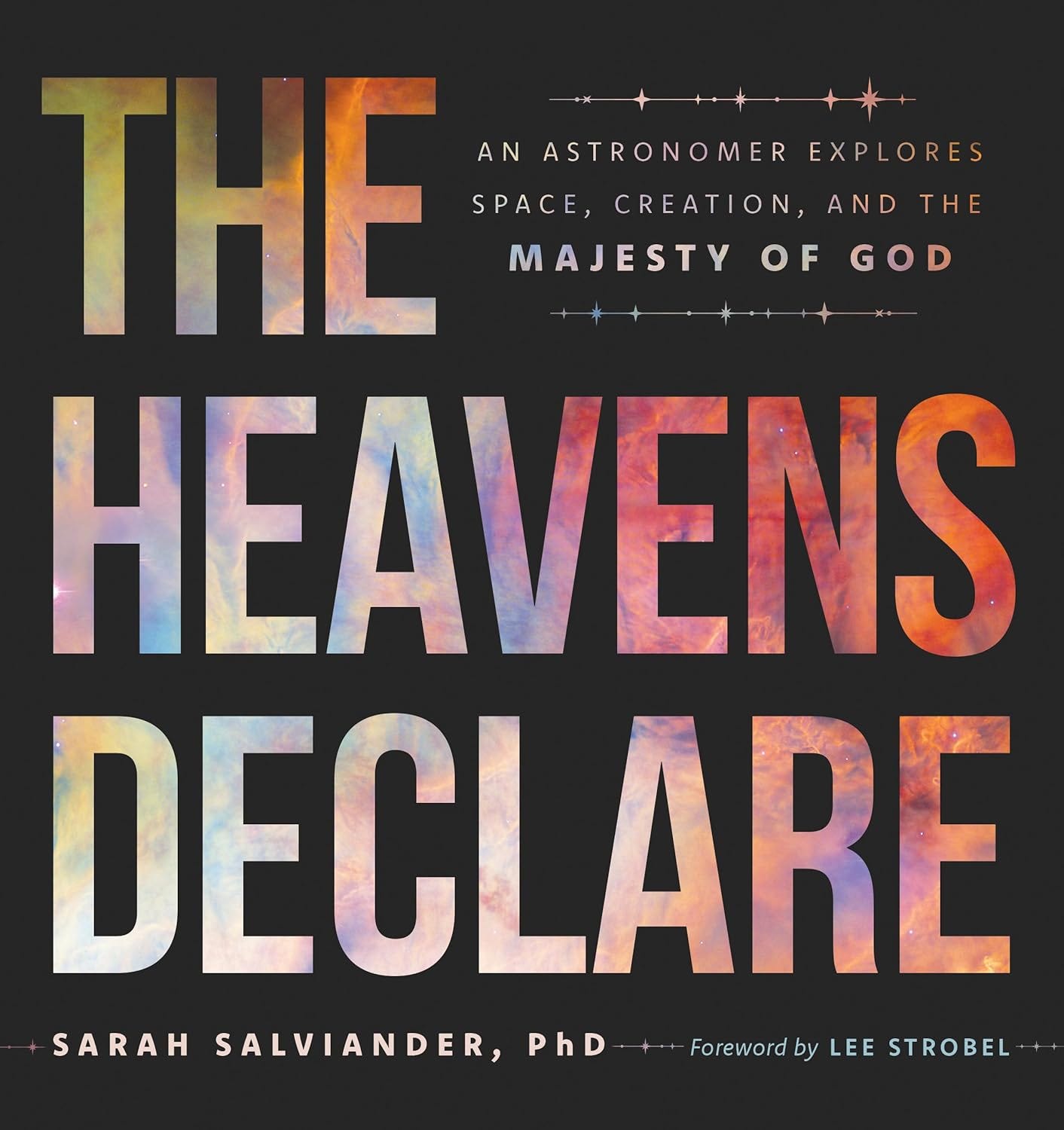
Y’all! I can hardly believe it, but it’s almost here… my first book, The Heavens Declare, comes out November 3rd. It explores the foundation of nearly everything I write here—science, Scripture, and how the heavens truly declare the glory of God and proclaim the work of his hands. I’ll write more about this in October, but if you want to be part of the cool club who receives my book on day one, you can preorder it on Amazon here.
Featured Science News
My favorite science news story of the month
Is consciousness evidence that we’re in a simulation?
[New Scientist Magazine]
Catherine Heymans, Astronomer Royal for Scotland, got dragged into the simulation question the way a lot of good science starts: a kid stalling at bedtime. Her son, newly addicted to realistic video games, asked if we might be living inside a simulation, but she didn’t have an answer before she had to fly off to Paranal for work. Under those Atacama skies, with telescopes on either side of her, the question kept pinging in her mind. Then long covid put her in a dark room where her brain still worked but her body didn’t, and she found herself wishing the “computational overlord” would just reboot her. So she did what any good scientist does when a problem won’t stop bothering her: she writes a book about it.
Her angle isn’t the usual “look for glitches in the Matrix.” As much as we like to think we sense these, in truth a sloppy simulation would’ve already given itself away. Instead, she asks an engineer’s question: what would you actually have to code to fake a world this good? You’d code light first—because every sense rides on electromagnetism—then gravity, then quantum mechanics, then some theory of everything to stitch it all together. To simulate the entire universe and keep it perpetually running you need something close to infinite energy, so she more or less rules that out. (This is where the believing scientist has the advantage in scope of explanation. God could certainly create an entire universe and keep it running.) What she couldn’t scientifically rule out was a smaller feat: a fully rendered “bubble” around you, with an energy-saving AI painting in the rest. (Nerd alert: a Star Trek: TNG episode called “Remember Me” explored this very idea.) She doesn’t buy Elon Musk’s version—that advanced civilizations will run so many ancestor simulations we’re almost certainly in one. If this were all just a game, we’d be doing things like driving motorcycles off cliffs every five minutes. If someone actually built this, she reasons, they built it the way I used to build galaxy-and-black-hole simulations: not for entertainment, but to study something we can’t bring into a lab. In this case, though, she believes “they” are studying consciousness.
That’s the part that stuck with me, and has stuck with many of the great philosophers, from Descartes to Lichtenberg. You know you are conscious, but how can you ever prove anyone else is? If consciousness arises from physics and biology, in principle you could code it and run a series of controlled worlds. For instance, you could simulate someone in a world with no music, no jokes, or no pain, then introduce those things and see whether the simulated person still reacts. If they do, you conclude they’re conscious. Personally, I don’t think that’s how it works. I believe consciousness is supernatural, not material, in origin, and can’t be simulated. Like any good scientist, I’m all for exploring consciousness scientifically—but I’d bet everything they’ll never crack this problem scientifically. The ethics of such experiments are rather ugly anyway, and few scientists would be willing to run them. Heymans talked to consciousness philosopher David Chalmers, who told her the line that actually helped: if you feel real, you are real, whether you’re made of quarks or qubits.
The Last Laugh
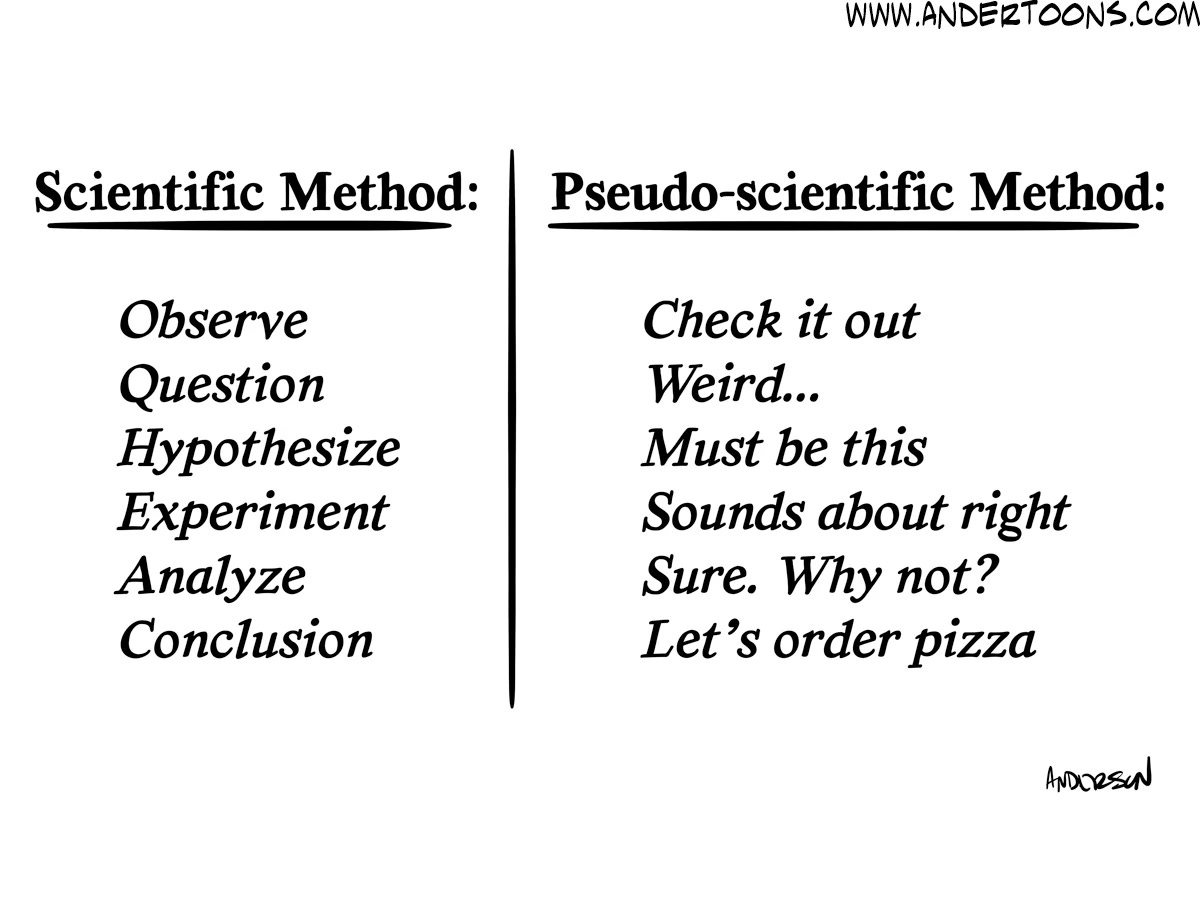
From Andertoons. This was more or less my grad school experience.

What’s a superposition?
It’s the quantum phenomenon in which a system exists as a combination of multiple possible states at the same time. Confusingly, it’s neither a simple “AND” (both happening together) or a classical “OR” (one or the other). Quantum superposition is a deeper, inherently ambiguous kind of possibility that produces effects no ordinary uncertainty can explain—that is, until a measurement “collapses” the system into a single outcome.
In the human world, we also exist as a combination of multiple possible states at the same time—faith and doubt, joy and struggle, wholeness and brokenness, the sacred and the ridiculous—all in perpetual superposition, until it gets collapsed into one reality in eternity.
If you enjoyed the article, I’d appreciate it if you click the like button below. It helps me see which topics resonate with readers and it boosts my articles. There’s also a share button if you’d like to send this to a friend who might enjoy the science-and-faith conversation.
Please also feel free to comment or ask questions below. If you’re new here, I encourage you to check out my FAQ first.
Superpositions basically explain existence; so much happening at once that doesn’t fit concretely into a binary.
It just is. That's brilliant.
Although not in the genre of science fiction, one example of mercy from literature/theater that overwhelmed me was a scene in Les Miserables. After Bishop Myriel invites Jean Valjean to stay with him, Valjean steals the Bishops silverware and runs off. When the police confront Valjean, the Bishop tells the police that the silverware was given to Valjean as a gift and then proceeds to give silver candlesticks to Valjean. The police accept the explanation and Valjean is not arrested. The Bishop then tells Valjean that God has purchased his soul and he should use the silver to become an honest man.