



The last Sunday of each month features Sunday Superposition, historically a special thank you for my paid subscribers, whose generosity helps keep me writing here each week and ensures that my content remains free. Each edition is a collection of candid personal story, my favorite science news of the month, and something to make you laugh. It’s truly one of my favorite things to create.
Access to this feature has changed over the years. Lately it’s functioned as an exclusive perk for my paid subscribers. I decided to make it a free feature again, but would like to retain the perk status. That means premium subscribers get first access (on 8/30) followed by free subscribers after one week (on 9/6). Enjoy, y’all.
I am the idiot
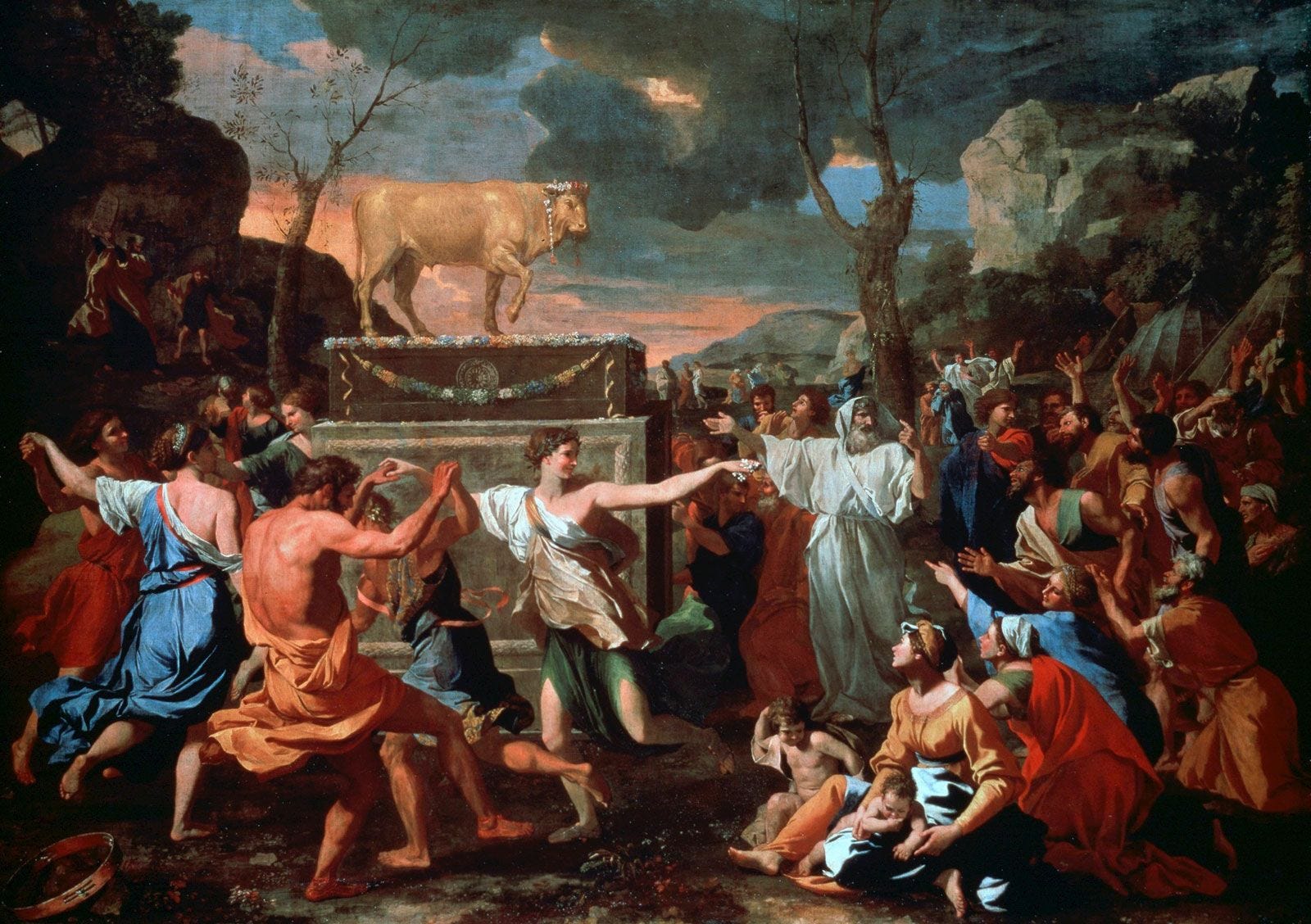
When I first read the Old Testament as a not-yet-Christian, I was puzzled by the Israelites. Why did they keep falling back into forbidden things—golden calves and high places, forbidden tables, the urge to be like the nations? Not just one or two times, but over and over. What a bunch of idiots, I thought. How many times did they need to fool around and find out? Just learn the lesson already!
It’s that simple, right?
Well, no. Let me tell you a personal story of falling back.
I have non-celiac gluten intolerance. For a long time, I was in denial about this. But even after I finally accepted it, I would fall back into my old ways, and every single time, my body rippled with the consequences. My fingers swell up like cooked sausages. My hands, shoulder, and neck feel arthritic. Nearly every part of my body is gripped by severe muscle cramps. My GI system is plagued by problems that are best left vague. My stomach burns as though it were a volcano about to shoot liquid hot magma through my navel. I get bogged down by nausea, migraines, and brain fog. I am flattened by severe fatigue. This carnival of maladies doesn’t just last a few hours, but up to three days.
Finally… FINALLY… I got the point: this was never going to stop. For several months, even looking at something I used to love, like a flaky, buttery-soft croissant would make my innards recoil. It became easy to avoid. I started declining bready things out of habit. But every few months I would still find myself thinking, Was it really that bad? What if I just had one croissant?
I’m a skilled baker, so I frequently get requests for my signature bakes. Two weekends ago, I made Swedish cardamom twists for friends. Look at this batch I made a while ago. Those warm, gently cardamom-scented layers of yeasty dough and buttery cinnamon-sugar… there just aren’t words to describe how heavenly this is.
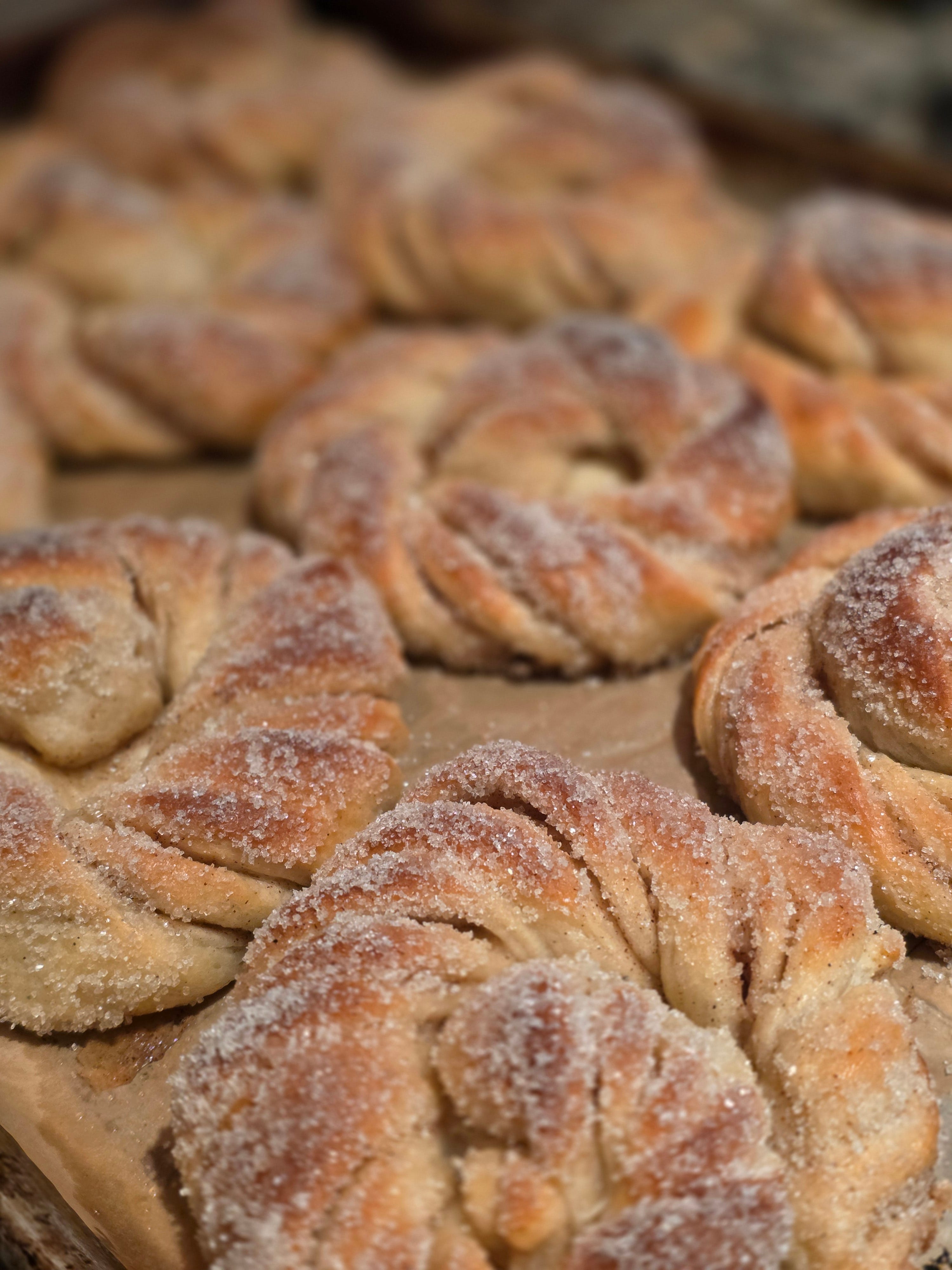
Confronted with this gluten-y temptation, my resolve began to weaken. I thought to myself, I’ll just try a small one—for science. It’s an experiment… yes, an experiment. Try the twist, gather valuable data. It had been months since my last tangle with gluten. Maybe, I reasoned, if I only have a baked goodie once in a while, the symptoms won’t be so severe.
(Narrator: They were severe.)
Maybe it wouldn’t have been so bad if I’d restricted myself to one small twist. But I ate three. All cognitive processes stopped after that first bite, and I literally could not stop myself.
Are the Israelites the idiots or am I? I am. I am the idiot.
So, why did I do it? Why wasn’t the knowledge of what had happened dozens of times before enough to stop me? Because I thought it would be different this time. Or not as bad. I already had plenty of data points—they all led to the same conclusion: misery. I ran the experiment anyway.
I admire people who only need to learn a lesson once. Is that most of us? I don’t know. It wasn’t the Israelites, it isn’t me, and given the cycles of history stained by human suffering, it isn’t the human race as a whole. Israelite foibles form a core of the Old Testament, because those same foibles form a core of our existence. There is nothing uniquely stupid about them—that stupidity defines an aspect of human existence. But you know what else forms a core of the Old Testament? God’s faithfulness. His refusal to back out of the covenant He made with them. The Israelites experienced the consequences—sometimes very severe—of the mistakes they made, but not once did God throw up His hands in frustration and say, “I’m done with you.”
When I read the Bible now after my conversion, I see the Old Testament in a different light. I see myself in those ridiculous Israelite foibles. I also see God’s patience, His steadfastness, His utter love for His people. I look at that and think, what an incredible God we have. I relate it to my own life: every time I fall down, He helps me back up. Never with recriminations, always with love. I have Jesus Christ, who paid the price for my mistakes, because I couldn’t. Who accepts me as I am, but who will never leave me that way.
I didn’t need another data point—I already had enough—and I didn’t need a better memory. Knowing the pattern of my foibles didn’t save me. What I needed was grace. Grace isn’t just giving me another chance, it’s letting God’s love conform me to the image of Christ. The miracle isn’t that God forgives once, but that he stays in the story after the tenth—or hundredth—stumble, after every Golden Calf and every golden cardamom twist. I may be the idiot, but He isn’t done with me.
If there’s anything you struggle with, rest assured He isn’t done with you, either.
Foundations for Faith
Many times he delivered them, but they were rebellious in their purposes and were brought low through their iniquity. Nevertheless, he looked upon their distress, when he heard their cry. For their sake he remembered his covenant, and relented according to the abundance of his steadfast love. —Psalm 106:43–45
For I do not understand my own actions. For I do not do what I want, but I do the very thing I hate. —Romans 7:15
But they and our fathers acted presumptuously and stiffened their neck and did not obey your commandments. They refused to obey and were not mindful of the wonders that you performed among them… But you are a God ready to forgive, gracious and merciful, slow to anger and abounding in steadfast love, and did not forsake them. —Nehemiah 9:16–17
If we are faithless, he remains faithful—for he cannot deny himself. —2 Timothy 2:13

Featured Science News
My favorite science news story of the month
NASA’s huge Nancy Grace Roman Space Telescope is about to launch
[New Scientist Magazine]
The Nancy Grace Roman Space Telescope—named for NASA’s first chief of astronomy—is scheduled to lift off from Cape Canaveral on August 30. (My favorite astrophotographer, Andrew McCarthy, is on location, ready to produce incredible shots. Be sure to follow him on X to get a front-row seat.)
Roman was constructed to operate in the same infrared wavelengths as the Webb Telescope, but with a completely different personality. While the JWST focuses deeply on a tiny patch of the sky, Roman will take a much shallower, but wider look into space. Each shot will cover an area about the size of the full Moon and with Hubble-level precision. That makes it roughly a thousand times faster at collecting data.
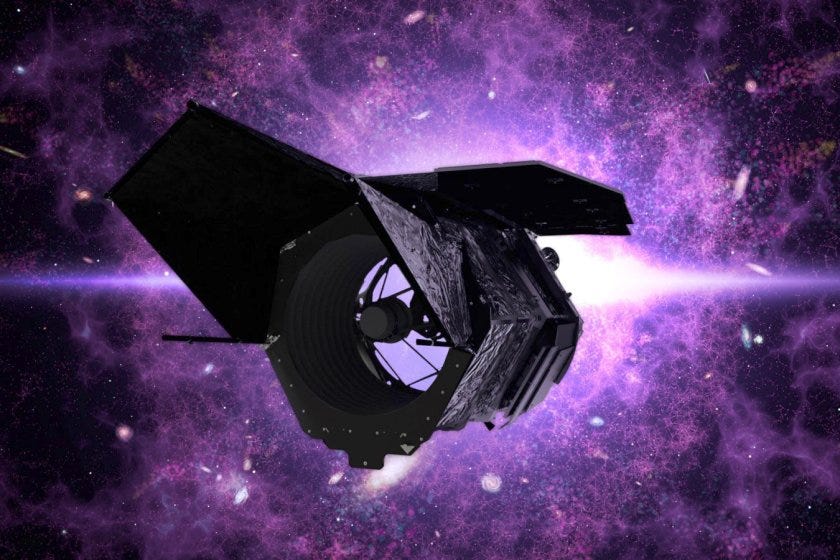
Roman was designed to observe a wide array of objects, including stars, galaxies, black holes, and exoplanets. It carries a coronagraph meant to directly image exoplanets a hundred million times fainter than their stars—the kind of demo that hopefully sets up the next astronomical flagship, the Habitable Worlds Observatory.
This new space telescope will also track the behavior of dark matter and dark energy across vast stretches of the universe with unprecedented precision. Over its five-year mission (cue the Star Trek theme) it will map 12 percent of the entire sky and look far back into cosmic deep history. Space missions like these almost always get extended, so it’s likely we’ll get a lot more out of Roman.
If the launch goes as planned, it will reach the L2 position—a gravitational balance point located about a million miles away, directly behind Earth and away from the Sun—in about a month, then spend another three months on instrument-checking and calibration. The first science images are expected around the start of 2027.
The Last Laugh
In honor of this 42nd edition of Sunday Superposition, here is the defining scene of Douglas Adams’ The Hitchhiker’s Guide to the Galaxy, from the BBC television production. A race of hyper-intelligent, pan-dimensional beings built a supercomputer called Deep Thought to answer the ultimate question of life, the universe, and everything. After seven and a half million years, it is finally ready to tell them the answer. The only problem? No one knows what the question is.
I fell in love with Adams’ books in high school, and I must have listened to the BBC radio production of the first two books a hundred times. Adams was an atheist who grappled with the consequences of his worldview with that characteristically British mix of dry wit, esoteric cleverness, and a touch of resigned melancholy. It was consolation for a lot of people like me at the time, who didn’t understand why we were partaking of this puzzling and at times absurd existence. I’m grateful to have more answers now, but I still get a hit of nostalgia from Adams’ work.
What’s a superposition?
It’s the quantum phenomenon in which a system exists as a combination of multiple possible states at the same time. Confusingly, it’s neither a simple “AND” (both happening together) or a classical “OR” (one or the other). Quantum superposition is a deeper, inherently ambiguous kind of possibility that produces effects no ordinary uncertainty can explain—that is, until a measurement “collapses” the system into a single outcome.
In the human world, we also exist as a combination of multiple possible states at the same time—faith and doubt, joy and struggle, wholeness and brokenness, the sacred and the ridiculous—all in perpetual superposition, until it gets collapsed into one reality in eternity.
If you enjoyed the article, I’d appreciate it if you click the like button below. It helps me see which topics resonate with readers and it boosts my articles. There’s also a share button if you’d like to send this to a friend who might enjoy the science-and-faith conversation.
Please also feel free to comment or ask questions below. If you’re new here, I encourage you to check out my FAQ first.
Your inspired writing resonates with many of us . . . thank you.
Always a great read. I'm kinda wanting a Swedish Cardamon Twist now though. Do you ship?