


I’m a huge fan of Andy Weir’s Project Hail Mary. When I first picked up the book, I couldn’t decide whether to devour it in a single binge or stretch the experience out as long as possible. It’s exactly my kind of novel: nuts-and-bolts hard science fiction packed with detailed (and mostly accurate) science, an urgent high-stakes plot, a slightly goofy and deeply relatable protagonist, and an unexpected but profoundly moving friendship.
So when I sat down to watch the movie adaptation, I wasn’t sure what to expect. What I got was… interesting. Not at all what I anticipated.
Where the book is a straightforward first-person narrative, the film leans interpretive, artistic, tonal, and almost poetic. It’s not quite the pure tone poem of Star Trek: The Motion Picture (which I love beyond all reason), but it echoes 2001: A Space Odyssey—that groundbreaking sci-fi arthouse classic that tells a vast, complex story largely through visuals and music. If I hadn’t read the book first, I’m not sure I would have caught everything unfolding on screen. The movie is visually stunning, superbly acted, and features wall-to-wall music that I sometimes found intrusive in the theater. I’m looking forward to a second viewing at home, where I can fine-tune the balance between score and dialogue.
Warning: mild spoilers ahead.
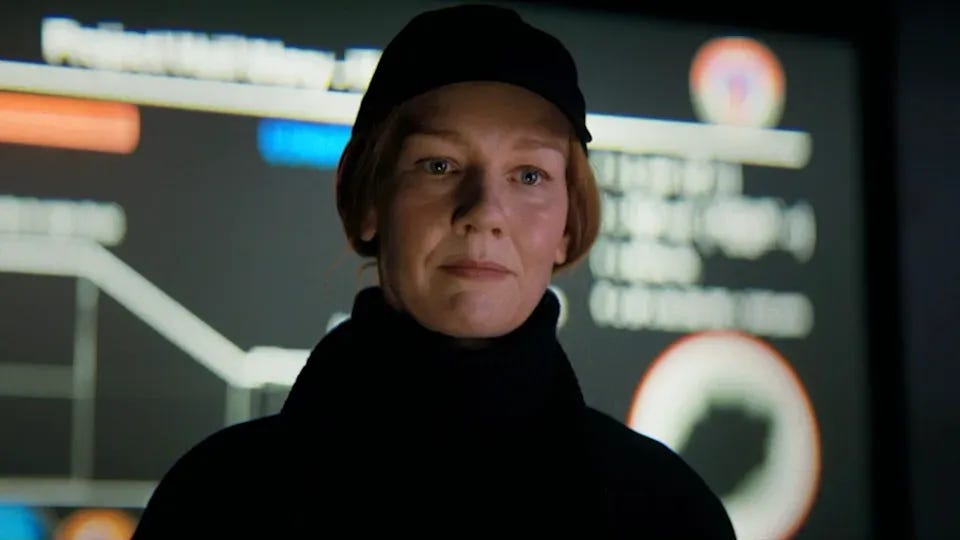
The story centers on Dr. Ryland Grace, a biologist turned middle-school teacher, recruited by the enigmatic and powerful Eva Stratt (played with quiet intensity by Sandra Hüller). The Sun is dying, infected by an Astrophage parasite, and half of Earth’s population will be wiped out in a matter of decades unless a solution is found. The stakes could not be higher.
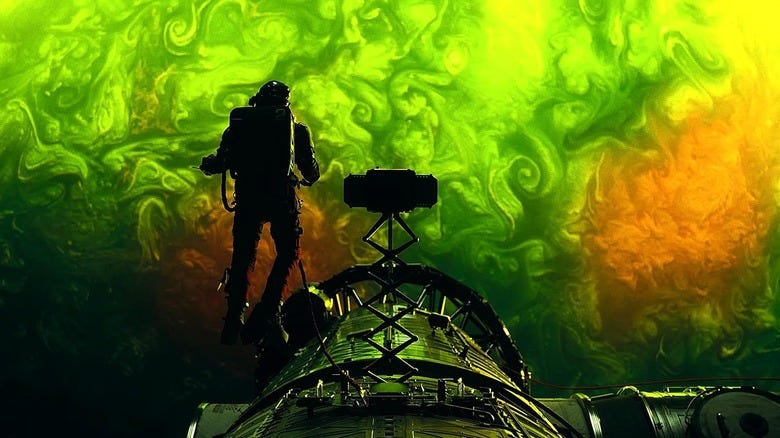
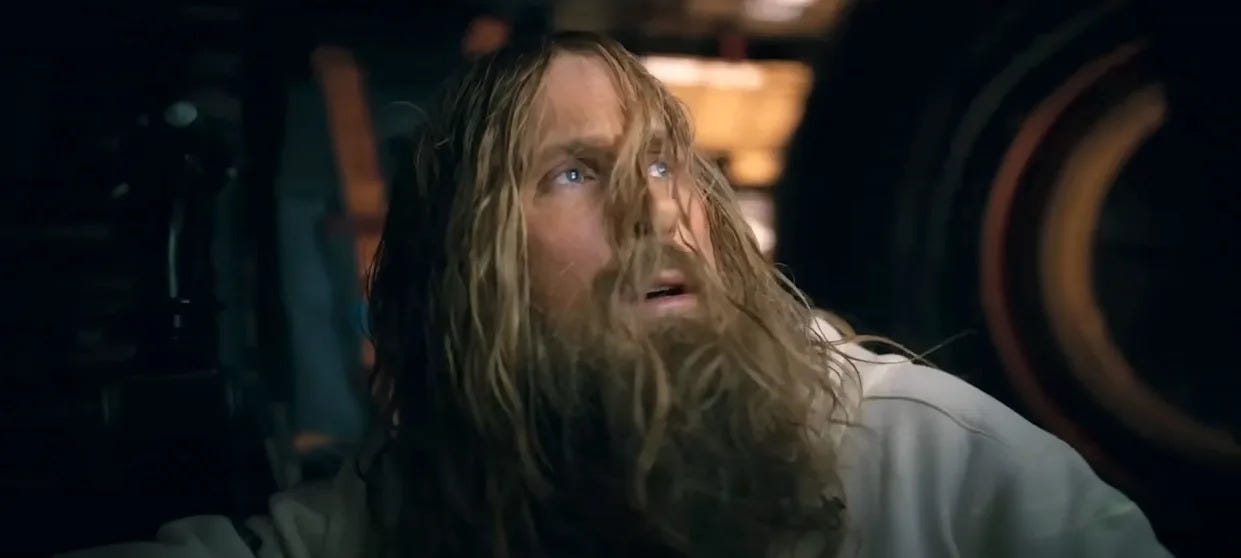
The film opens much like the book: Grace awakens from induced coma aboard the Hail Mary, an interstellar spacecraft hurtling toward the Tau Ceti star system. He has no memory of who he is or why he’s there. Through a clever, low-tech experiment, he realizes he’s in an environment with 50% more gravity than Earth. The narrative unfolds in two braided threads—Grace piecing together his mission in the present, and flashbacks revealing how he ended up on this one-way suicide trip.
He learns he’s racing to Tau Ceti, the only nearby star not yet fully consumed by Astrophage. His task: discover why, find a cure, and send it back to Earth. There were other crew members, but they didn’t survive the long sleep. Grace is alone—until he isn’t.
The movie’s three central characters—Grace, Stratt, and the alien Rocky—carry the emotional weight of the story. In the book, Stratt is cold, calculating, and almost villainous in her single-minded drive to save humanity, a kind of reverse-Thanos with godlike authority and a sharp tongue. The film softens her edges. Hüller brings a layer of melancholy and quiet regret that makes her more human without diluting her power. She does what must be done, but it clearly costs her.
One of the film’s most captivating scenes comes just before launch, when the team unwinds with karaoke. Stratt unexpectedly takes the mic and delivers a beautiful, haunting song. Later, when the full weight of her decisions is revealed, Hüller masterfully balances steely resolve with deep sorrow. Ethics classes will be debating Eva Stratt for years.
Then there’s Rocky.
The promotional materials make no secret of him, so I won’t either: Grace encounters an enormous alien vessel at Tau Ceti. What follows is one of the most delightful first-contact stories in recent memory. Rocky, the last survivor of a crew from the 40 Eridani system, is genuinely alien—a five-legged, spider-like rock creature with no face, who “sees” via echolocation and “speaks” in trilling musical notes. He’s an engineering genius whose skills perfectly complement Grace’s knowledge of biology and astrophysics.
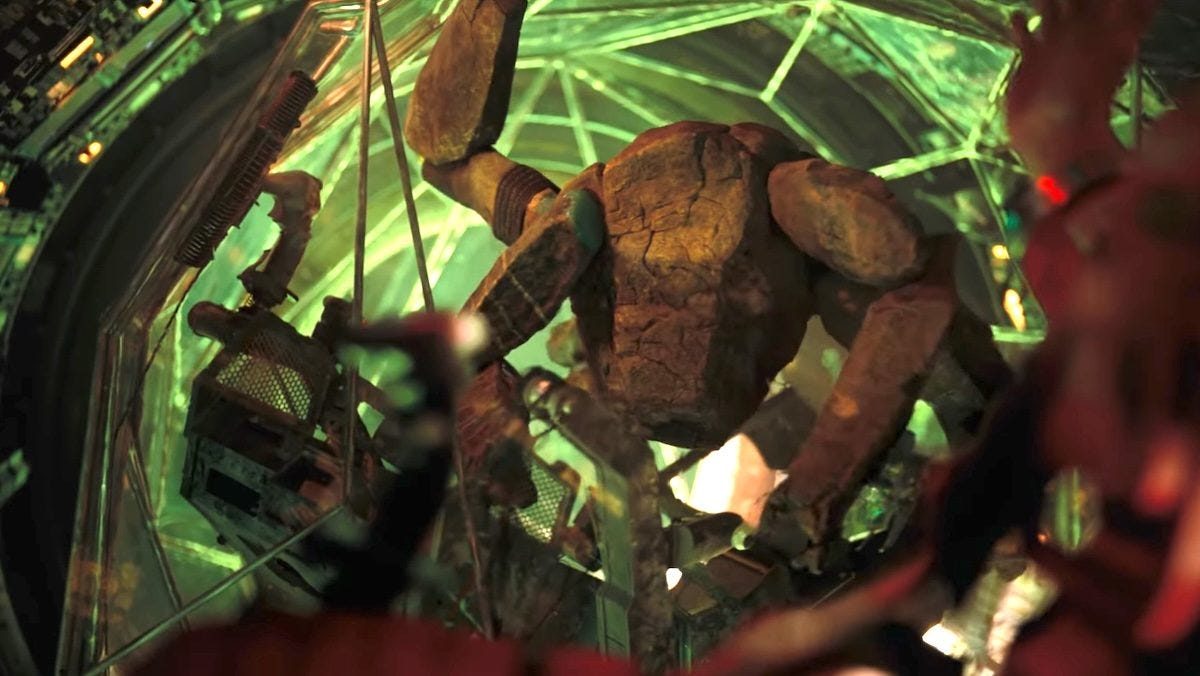
The film (and Weir’s original story) handles Rocky with real respect. Unlike most sci-fi aliens who are basically humans with latex appliances glued to their faces, Rocky feels truly alien. Yet through ingenuity, patience, and humor, the two forge a deep friendship. They save each other’s lives. Rocky watches over Grace while he sleeps—a necessity for Eridian biology that Grace comes to find comforting. Their eventual parting carries genuine emotional weight, knowing the vast distances between their stars means they’ll never communicate again.
The resolution? You’ll have to experience it yourself—preferably by both reading the book and seeing the movie.
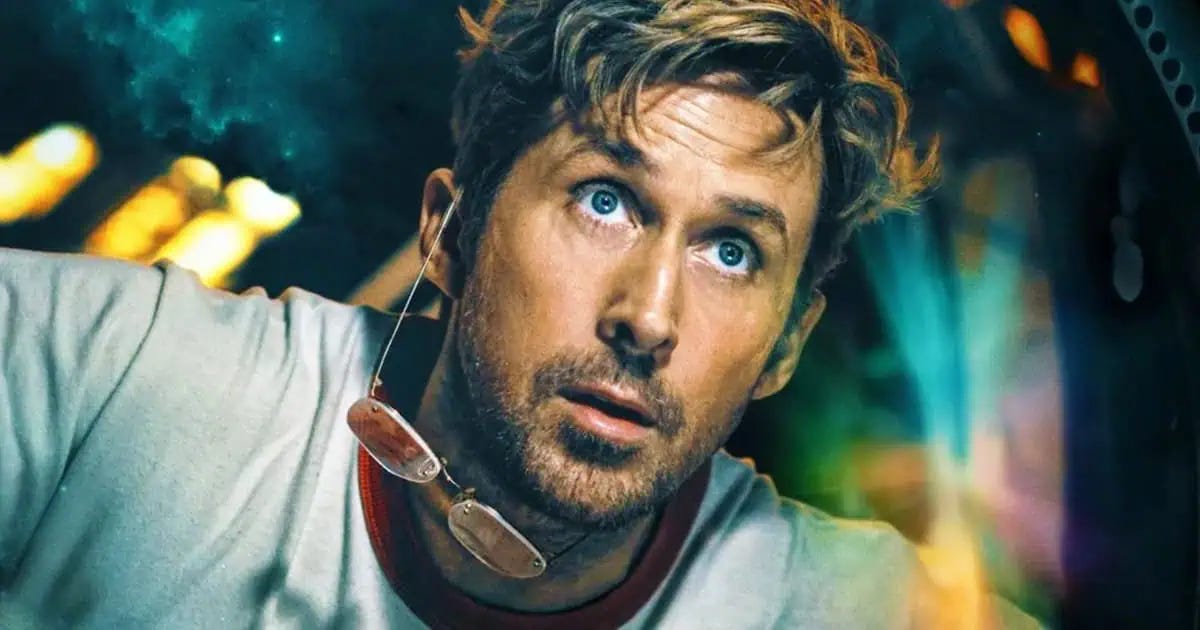
Visually, Project Hail Mary is a triumph. The practical sets and effects are breathtaking, with Rocky realized largely through puppetry rather than pure CGI—a choice that gives him tangible presence. Ryan Gosling delivers one of his strongest performances yet as Grace: funny, vulnerable, brilliant, flawed, and heroic in the most human way.
The movie has the crowd-pleasing energy of something like Top Gun: Maverick, but with a more contemplative, wonder-filled soul. It’s the kind of big-screen spectacle that reminds us why we go to theaters.
Documentary filmmaker Marcus Pittman stirred up discussion on social media by calling Project Hail Mary a Christian movie. He faced pushback—especially from some Christians—accustomed to overt “faith-based” fare that often prioritizes altar calls over artistic integrity. Pittman points to the symbolism: a man named Grace on a ship called Hail Mary, who sacrifices himself to save humanity; death-and-resurrection motifs; the two deceased crewmates echoing the thieves at Golgotha; the four canisters sent back to Earth with the power to save everyone like the four Gospels; even Rocky as “the Rock.”
Whether you read it as explicitly Christian or not, the film carries a powerful undercurrent of grace, sacrifice, and hope. The movie adds a quiet line from Stratt that I don’t remember reading in the book: when asked if she believes in God, she replies softly, “It’s better than the alternative.” In a massive blockbuster, that moment lands with surprising resonance. I still get chills when I think about it.
I relate to Pittman’s frustration with much of modern Christian entertainment. Too often it trades the difficult substance of faith for an easy veneer. As Tolkien scholar Ralph C. Wood observed, the best art can be “all the more deeply Christian for not being overtly Christian.” Tolkien himself refused to turn his epic into mere allegory, preserving the integrity of both story and witness.
That’s how seeds get planted. Growing up atheist in secular Canada, my only real exposure to Christian themes came through Star Wars and The Lord of the Rings. They awakened in me a hunger for the spiritual that overt preaching never could have reached at the time. Good stories weave truth into the world subtly, beautifully, and memorably.
Project Hail Mary does exactly that. It’s a gorgeous, well-acted, scientifically grounded adventure with heart, humor, and a quiet but profound spiritual dimension. Whether you’re in it for the hard sci-fi, the unlikely friendship, the stunning visuals, or the deeper themes, it delivers.
Go see it on the big screen while you can. Then read (or reread) the book. Slowly, if you can. You won’t regret prolonging the experience.
If you made it this far—thank you!—and liked my article, do me a favor and hit the like button below. This helps me understand which topics resonate with my readers, and it boosts my writing. There’s also a share button if you want to send it to a friend who’d enjoy the science-and-faith conversation. If you’re a free subscriber who would like to support my work, please consider upgrading to a paid subscription.
“The world does not need more Christian literature. What it needs is more Christians writing good literature.”
-C.S Lewis
I’m not making any claims about the religion of Andy Weir or the people who worked on this movie, but I think the sentiment applies.
I wanted to see it anyway but now all the more.