


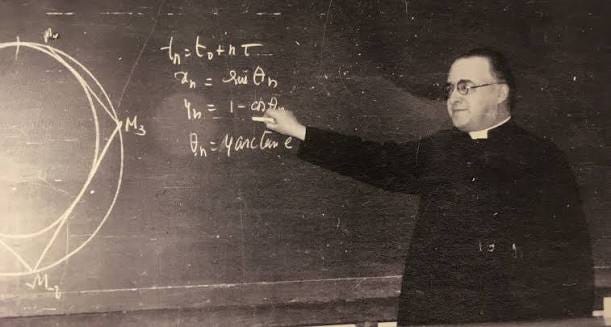
The juxtaposition of the title and subtitle may seem paradoxical, but let me show you what I mean. We’ll begin with one of my favorite figures in the history of modern science: Georges Lemaître, the Belgian priest and cosmologist widely regarded as the father of the Big Bang. His story is full of intellectual drama, steady faith, and the intriguing interplay between science and Scripture.
In 1915, Einstein published his groundbreaking general theory of relativity—a towering achievement of pure reasoning about how space and time curve and bend under the influence of matter and energy. The equations at its heart form a set of ten complex, interconnected equations (known as nonlinear partial differential equations). These describe how gravity works on the grandest scales, but they are notoriously difficult to solve exactly. Even Einstein himself expressed pessimism, believing the mathematics was so intricate that meaningful solutions might remain beyond reach.
But a German physicist named Karl Schwarzschild quickly proved him wrong. While serving on the front lines of World War I, he found the first exact solution: one that described what we now call a black hole. These strange objects were already startling to early 20th-century minds (Kip Thorne’s book Black Holes and Time Warps tells the story vividly). But Lemaître soon found something even more revolutionary.
Working with Einstein’s equations, he showed that the universe could not be eternal and unchanging, as philosophers and scientists had assumed for over two thousand years. Instead, it had to be dynamic—either expanding or contracting over time.
Einstein famously resisted at first, telling Lemaître, “Vos calculs sont corrects, mais votre physique est abominable.” (“Your calculations are correct, but your physics is abominable.”) When American astronomers, Edwin Hubble and Milton Humason, provided clear observational evidence that galaxies are racing away from us, the universe’s expansion became undeniable. Einstein eventually accepted the truth: the cosmos is dynamic and had a beginning.
This was unsettling for many who preferred an eternal, static universe. But for Christians, it was profoundly encouraging. It aligned strikingly with the opening words of Genesis: “In the beginning, God created the heavens and the earth.” Pope Pius XII embraced Lemaître’s “hypothesis of the primeval atom”—the early version of what became Big Bang cosmology—as consistent with the idea of creation.
Lemaître, however, remained cautious. He gently advised the Pope not to tie Christian faith too tightly to any specific scientific theory. Science moves forward, theories get refined or even replaced. Christian faith and science are deeply complementary and mutually supportive, but ultimately they serve different roles.
So what should a science-loving Christian do when new data challenges the details of our best models?
Take a broader view.
The evidence that the Sun, not the Earth, sits at the center of our Solar System is rock solid and isn’t going anywhere. In the same way, the core truth that our universe had a beginning, has been expanding ever since, and continues to change over time seems extraordinarily secure. You might object that the Pope was therefore right to place his trust in Lemaître’s theory, but this is hindsight. After a hundred years, the theory has earned that trust. Yet the finer details of how and when things happened are still being worked out as bigger and better instruments and experiments bring us fresh surprises.
For instance, the James Webb Space Telescope has revealed surprisingly mature galaxies appearing far earlier than many expected—perhaps as soon as a few hundred million years after the Big Bang. These findings have shaken up some assumptions about how quickly structure formed in the early universe. But they haven’t overturned the bigger picture: a universe with a definite start that has been changing and expanding ever since. The broad story matters more than the latest technical refinements.
James Clerk Maxwell, one of the greatest physicists of all time, put it this way:
“I think men of science as well as other men need to learn from Christ, and I think Christians whose minds are scientific are bound to study science that their view of the glory of God may be as extensive as their being is capable. But I think that the results which each man arrives at in his attempts to harmonize his science with his Christianity ought not to be regarded as having any significance except to the man himself, and to him only for a time...”
As a new Christian, I was enthusiastic about Gerald Schroeder’s work reconciling Genesis 1 with modern science. I had great trust in his unique perspective as a physicist and Jewish theologian, and I wanted to show it to Maxwell and say, “This has significance for everyone!” While I still think Schroeder’s approach is insightful, compelling, and probably correct, I’ve learned not to put all my eggs in any particular scientific or exegetic basket. It may turn out he’s not exactly right about every aspect of his interpretation. That’s okay, because whatever happens, the broader harmony remains.
I do find these detailed points of resonance between modern science and Genesis deeply intriguing and exciting. They enrich my sense of wonder and invite me to see the Creator’s handiwork with fresh eyes. At the same time, I resist tying my faith to any specific scientific detail. Comparing Scripture with the latest discoveries can teach us meaningful things about the order, beauty, and purposeful unfolding of creation, but we must be careful not to place too much weight on particular details proving true or false. Scientific understanding will continue to develop. And while God’s Word doesn’t change, our understanding of it can also develop.
Genesis gives us a clear arc: a definite beginning, followed by a purposeful progression from formless chaos toward order, complexity, life, and ultimately to humankind. It’s hard to imagine future discoveries in either science or biblical exegesis overturning this outline.
But the details? They’re kind of fluid.
For instance, I’m especially fond of the idea of cosmic inflation—the proposal that, a tiny fraction of a second after the beginning, the universe underwent a brief, explosive period of expansion. Space itself stretched dramatically and rapidly, helping explain the remarkable smoothness we observe across the cosmos and setting the stage for the large-scale structures that later formed. It carries a poetic echo of Genesis 1:2, where “the Spirit of God was hovering over the face of the waters.” What does this mean? The Hebrew word for waters (mayim) can mean other kinds of fluid, and the word used here for spirit (ruach) can also mean a gust of wind or a powerful exhalation. To me, this is strongly suggestive of God triggering a rapid early expansion in a universe that, according to particle physics, was in a perfectly fluid-like state at that stage.
Scientists are actively hunting for direct evidence of inflation, primarily by searching for a distinctive subtle twisting signature imprinted on the cosmic microwave background radiation—the faint afterglow of the Big Bang. Experiments like BICEP (at the South Pole) and upcoming missions such as LiteBIRD are designed with exquisite sensitivity to detect these incredibly faint signals.
Yet we may never find conclusive evidence for inflation, and my interpretation of Genesis 1:2 might be way out in left field. But that’s okay.
My confidence in God and His Word does not depend on any scientific theory holding up in every detail. The broad sweep of Genesis 1 fits remarkably well with what we observe: a created universe that began and then unfolded with purpose. The details are delightful—they invite wonder, discovery, and deeper worship of the Creator. But they are not the main thing.
As Ecclesiastes 3:11 reminds us, God has made everything beautiful in its time. We can enjoy scientific mysteries. We can let them stir awe, drive our curiosity, and draw us closer to the One who spoke the cosmos into being. But in the end, whether galaxies formed a few hundred million years after the beginning or whether inflation happened exactly as we hypothesize—these questions, fascinating as they are, remain secondary. The exact date of galaxy formation is not going to win or lose souls. What matters eternally is knowing the God who set it all in motion and who offers us redemption through Jesus Christ. There is abundant of evidence for both, because God wants us to come to Him. Enjoy the details, but rest in the broader view.

If you enjoyed the article, I’d really appreciate it if you hit the like button below. It helps me see which topics resonate with readers and it boosts my writing. There’s also a share button if you’d like to send this to a friend who might enjoy the science-and-faith conversation.
Please also feel free to comment or ask questions below. If you’re new here, I encourage you to check out my FAQ first.
If you’re a free subscriber and would like to support my work, please consider a paid subscription. Researching and writing these pieces takes time and effort, but I’m committed to keeping my best work—and the vast majority of my content—free for everyone. The generosity of my paid subscribers makes that possible.
Thanks for this timely perspective… I was talking with a friend recently about human (aka scientific) knowledge… and I liken it to a balloon… all we know and learn is contained within the balloon… God is both what’s within AND outside of the membrane of the balloon… as Buzz Lightyear said “To infinity and beyond “!
I love this story about Einsteins struggles with the truth hidden in his math. Most people have never heard about it. Every Christian who believes science is their enemy should read about it. The strange part is that in spite of Genesis 1:1 the Church believed in an eternal universe for centuries because of their respect for the thinking of Aristotle.