


The last Sunday of each month normally features Sunday Superposition, a collection of candid personal story, a hand-picked roundup of exciting science news, and something to make you laugh. It’s a special thank you for paid subs, whose generosity helps keep me writing and ensures that most of my content remains free—truly one of my favorite things to create. But this one’s particularly special to me, so I’m making it freely available to all my subscribers.
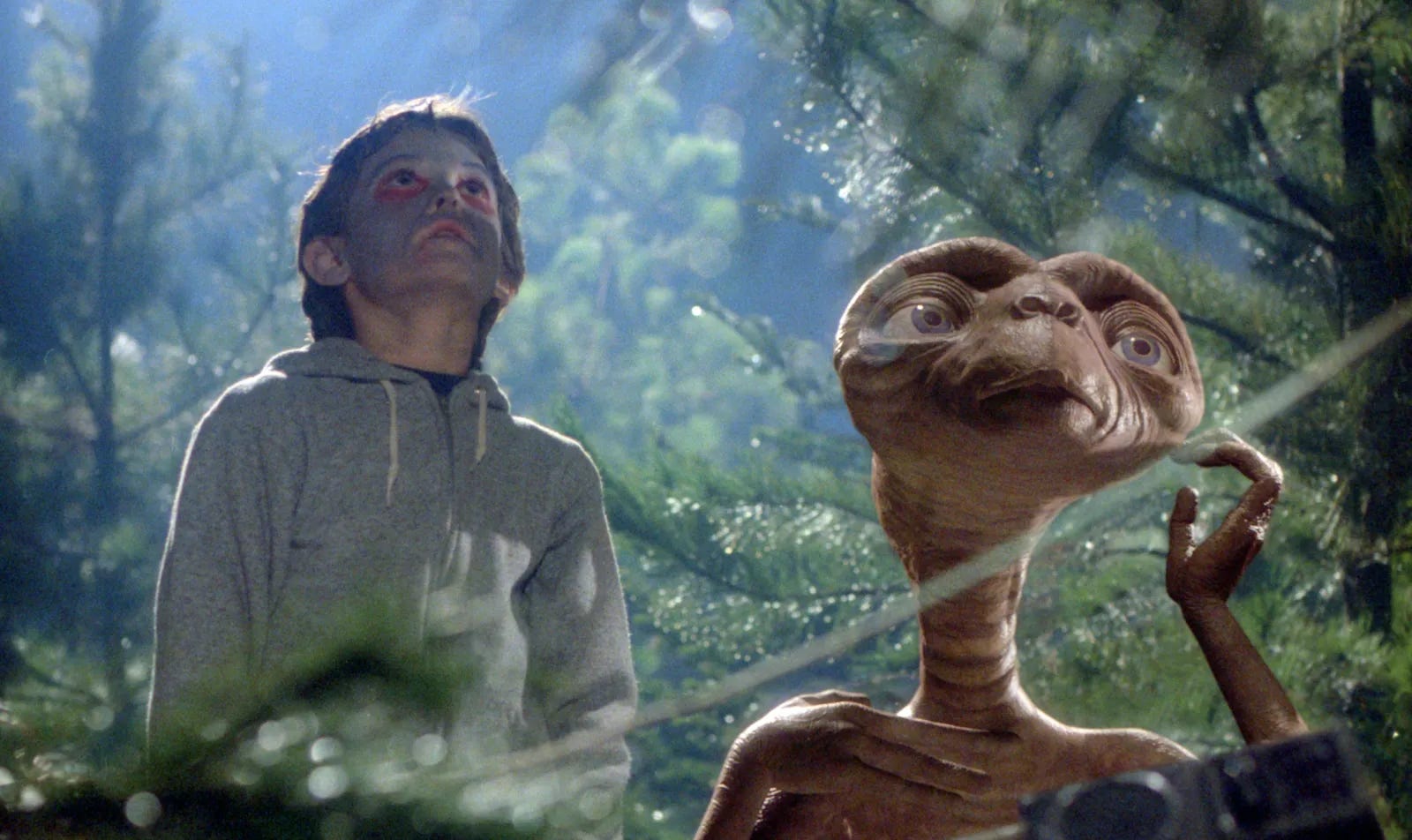
I was eleven the first time I saw E.T. the Extra-Terrestrial. By then my parents had separated and were on their way to divorce. Like Elliott, I knew what it meant to be a kid whose world had quietly fallen apart, lost in the chaos while grown-ups sorted out their own wreckage. When that small, frightened alien shuffled out of the shed and into Elliott’s life, the recognition was instant: here was someone even more lost than I was. But the movie insisted that a lonely kid and a stranded extraterrestrial could save each other.
Years later I watched it again with my husband and daughter. The iconic John Williams score swelled, the kids’ bikes rose up against that perfect moon, and without warning I was crying so hard I had to pause the film and leave the room. Some of it was nostalgia, but mostly it was the sudden, visceral memory of exactly how alone I felt at that age, and how tenderly the movie had captured that ache without ever turning it into cheap sentiment. That was Spielberg’s particular gift.
Spielberg’s films were the shared mythology of my generation. We thrilled to Raiders of the Lost Ark in theaters, got genuinely freaked out by Jaws on TV, and felt an eerie sense of wonder during the TV broadcast of Close Encounters of the Third Kind. E.T. was simply the culminating event, the one that felt like it had been made for millions of kids like me who were already carrying a quiet sadness they couldn’t name.
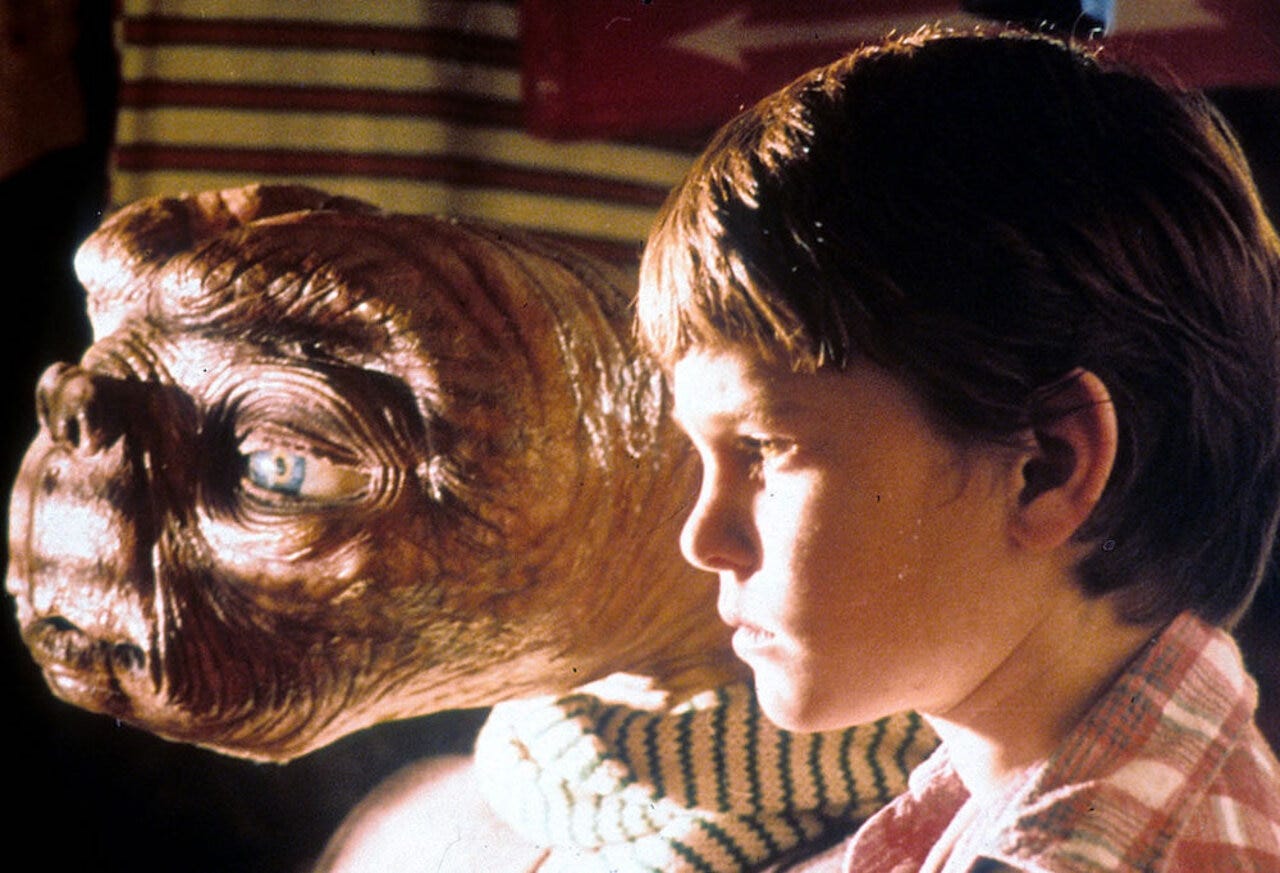
Spielberg has directed more than thirty feature films and produced or executive-produced dozens more. But in cultural terms he remains the “extra-terrestrial director” of my generation, the one who most powerfully shaped how we picture contact with the unknown. He has made five films that directly involve extraterrestrials or “interdimensional” beings: Close Encounters of the Third Kind (1977), E.T. the Extra-Terrestrial (1982), War of the Worlds (2005), Indiana Jones and the Kingdom of the Crystal Skull (2008), and this year’s Disclosure Day.
Why does Spielberg keep returning to this theme? I think it’s because even the most brilliant and creative secular imagination still hungers for the transcendent. When someone has no traditional religious framework, the need for awe, for something unimaginably greater than oneself, has to go somewhere. For Spielberg it has gone into the possibility of intelligent life from elsewhere—beings who might finally make the universe feel less indifferent.
There was some mild controversy around Disclosure Day when Spielberg suggested that genuine disclosure might cause Christians to question their faith. Skeptics like Michael Shermer were quick to point out how surveys show most Christians are not threatened by the idea of extraterrestrial life. In fact, they’ve been quietly discussing it for decades. C.S. Lewis addressed the same question head-on in his 1958 essay “Religion and Rocketry.” He argued that the discovery of alien life would pose no fundamental threat to Christian theology. God could have purposes for other worlds we cannot imagine—some unfallen, some fallen and redeemed in ways we cannot yet grasp. The vast distances between stars might even function, Lewis speculated, as a kind of quarantine, protecting other civilizations from the contagion of human sin. His Space Trilogy (beginning with one of my all-time favorite novels, Out of the Silent Planet) imagines exactly that kind of rich, theologically serious cosmos: other planets with their own rational beings, their own relations to the divine, their own stories unfolding under the same ultimate Lord.
Spielberg’s first and third Indiana Jones films remain the strongest because their mysteries are rooted in that same theological richness—Judaism and Christianity. The artifacts Jones pursued carried real historical and theological weight and a real sense of danger. (The second film, Temple of Doom, was darker and more horror-tinged; George Lucas, who wrote the story and produced, has acknowledged that the bleak tone reflected his own difficult personal life during a bitter divorce.) The fourth film, Indiana Jones and the Kingdom of the Crystal Skull, felt thin compared with the first three. The crystal skull never generated the same sense of genuine mystery or consequence as the Ark or the Grail, and for all the film’s visual spectacle, the ending’s interdimensional departure felt more like a shrug than a revelation.
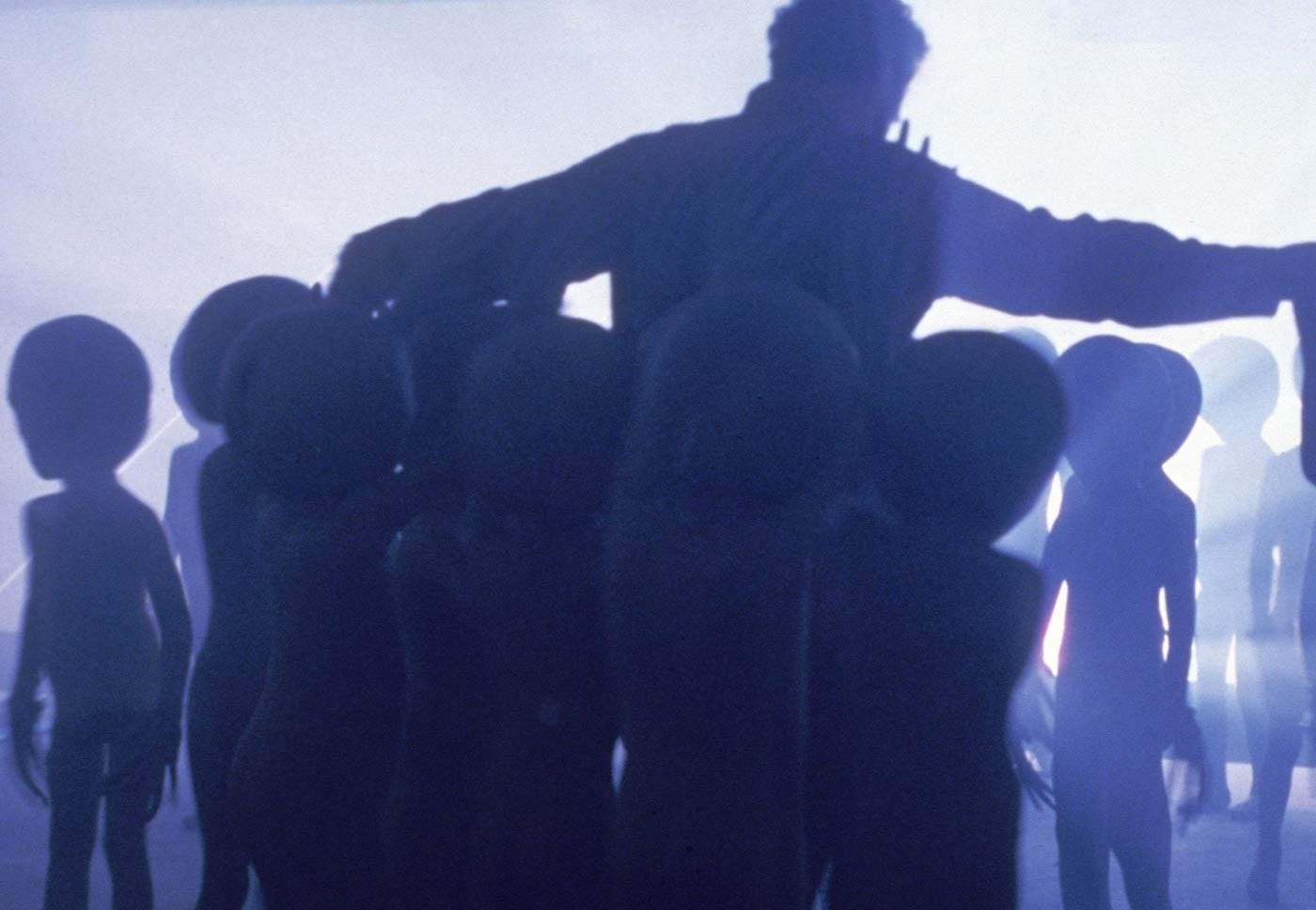
E.T. worked because it never relied on spectacle alone. It earned its emotion through the patient, believable friendship between a boy and an alien who both needed to be found. Without that relationship, without the ache of “phone home,” the movie would have been just another effects showcase. Close Encounters built extraordinary tension and delivered one of the great awe sequences in film history, but even Spielberg later admitted he would not make the same movie today. At the time he was not yet a father; after he had children, the scene in which Richard Dreyfuss’ character simply walks away from his family became unthinkable. And there has always been something quietly unsettling beneath the wonder of the encounters: the aliens abduct a child, they study humans, and they use humans as messengers. The film never fully resolves whether they are benevolent or merely curious. That ambiguity has grown more disturbing to me with time, particularly with recent discussions about the possible connection between alien encounters and the demonic.
Spielberg’s later films feel more superficial by comparison. Kingdom of the Crystal Skull leaned into 1950s B-movie energy—Commies, nukes, goofy alien skulls—without the mythic or emotional depth of the earlier entries. Disclosure Day, from everything I’ve seen so far, seems more interested in procedural conspiracy and contemporary humanism than in the kind of transcendent mystery Spielberg once depicted so effectively.
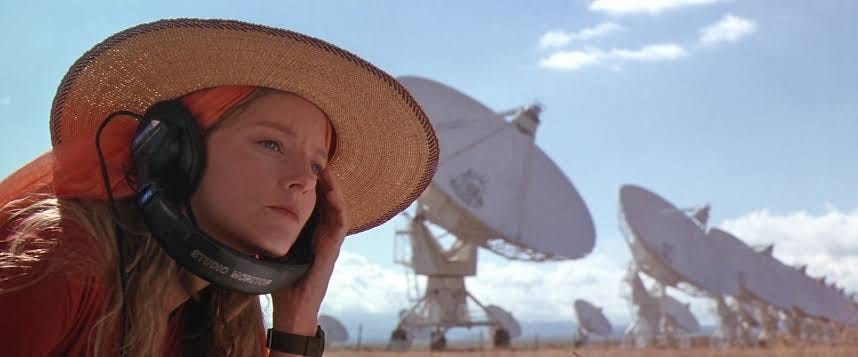
Carl Sagan’s Contact (both the book and the 1997 film) took a different path and, for me, remains more intellectually honest than Disclosure Day. Jodie Foster’s Ellie Arroway detects an intelligent signal from the star Vega that turns out to be a blueprint for some kind of transport. The religious implications are handled thoughtfully, with balance between a sympathetic Christian friend, a roadblocking government official, and a creepy religious fundamentalist. Despite concerns (mostly on the government side), the transport gets built and Ellie travels through a wormhole system. She meets an alien who appears to her as her deceased father and explains that the wormholes were built by some ancient, vastly older race. The aliens themselves are gentle and curious, but they are also searching, also limited, also in awe of whatever built the network. “What happens next?” Ellie asks the alien. “Small moves,” he tells her. The story ends with Ellie returning to Earth unable to prove what happened, carrying only the conviction that we are not alone. It’s beautiful, scientifically literate, and simultaneously deep and restrained in emotion. But it also refuses to answer our deepest questions. We learn that friendly intelligences exist, but almost nothing about them or their makers. Sagan’s work is thoughtful and elegant, but ultimately it just kicks the can down the road.
I understand that impulse to seek connection and answers. As a kid raised without religion, I got my sense of wonder from the universe. I devoured Sagan’s TV series, Cosmos, as a kid. Years later, I discovered the 1976 documentary simply called Universe, narrated by William Shatner. The images of galaxies and nebulae, the calm certainty that everything operated according to discoverable laws, gave me a kind of secular liturgy. In my early twenties, during an especially difficult time in my life, I watched it over and over. I would walk to the community college library down the street from my crummy little apartment, check out the Universe VHS from the AV desk, and sit in one of the carrels with headphones on consoling myself with Shatner’s reassuring voice and those vast images of space. This was the closest thing I had to church. My heart was hungry for connection to something far larger than myself, and the universe was the only candidate I knew.
Contact came out a few years later, the summer my grandfather died. Our whole family, still raw over the sudden loss, went to see it together. It offered a few hours of shared awe and a temporary sense that maybe the universe had patterns that included us. None of us had yet found God, and in the years that followed we each had to reckon, in our own ways, with the fact that the universe—however beautiful—does not care that we exist. Sagan’s famous line that “we are a way for the cosmos to know itself” is poetic, but it's also a half-truth. We are part of the universe, but we are not the universe. We are finite creatures who wake up one day as squalling infants and, if we’re lucky, live perhaps eighty or ninety years—a flicker against cosmic timescales—before leaving behind grieving creatures who repeat the cycle. From a purely naturalistic perspective, the eventual heat death of the universe renders every human story, every act of love or courage or creativity, ultimately meaningless. That this fate lies incomprehensibly far in the future does not change the logic; it’s simply another way of kicking the can.
I didn’t think that far when I was an atheist. What troubled me more immediately was the problem of morality. If the universe is all that there is, where does “ought” come from? Why is kindness better than cruelty, or truth better than lies, in any ultimate sense? When I could not derive objective morality from the brute facts of existence, I experienced a quiet crisis and did what many atheists do: I back-burnered the question. I buried myself in physics textbooks and Star Trek reruns and the half-acceptance that there was no good answer.
The following year I began to see, through the study of the universe itself, reasons to believe in God. The fine-tuning of physical constants, the unreasonable effectiveness of mathematics, the existence of objective moral obligations—these pointed, for me, to a mind behind the cosmos and a lawgiver behind the moral law. That belief did not merely answer intellectual questions, but poured balm into the ache that science and science fiction had only ever been able to name.
As someone with Asperger’s, I have always been a little inwardly drawn and stressed by new social situations. For that reason, unlike Spielberg, I have never found the prospect of extraterrestrial intelligence particularly exciting or comforting. But part of that may simply be that I grew up on a steady diet of Star Trek—the original series and The Next Generation. Those shows taught me to expect that what waits “out there” is not a race of serene, hyper-intelligent beings who will fill us with transcendent awe and answer our deepest questions, but more of what we deal with on Earth: irrational, petty, violent, complicated people who only look a bit different from us. The drama is diplomacy and exploration, not mystical revelation.

Gene Roddenberry’s secular solution was elegant in its own way. He imagined a future most of us long for, in which humanity has solved its practical and social problems, Earth is united, and a Federation of planets extends that unity across the stars. It’s a profoundly hopeful, this-worldly vision—almost aggressively non-mystical. (The first Star Trek film, The Motion Picture, which Roddenberry had little to do with, is the outlier: a genuine masterpiece of wonder that borrows heavily from religious imagery.) But without conflict, there was no drama, so the human problems in Star Trek were just transferred to other worlds, where Kirk and Picard battled against irrationality and superstition and found wonder in discovery and friendship.
For all of Roddenberry’s practicalizing the future and outer space, the vast majority of human beings carry an inborn need for connection to something larger than themselves. Christianity has met that need for billions of people across centuries and cultures. It offers the mystery and grandeur we crave—the sense of a reality unimaginably vast, powerful, and beautiful—while grounding it in something even deeper: Love. Not abstract benevolence, but a personal, pursuing, cosmic-sized love that desires not just to smile condescendingly at us from a distance, but to adopt us as heirs into a divine family. Awe and belonging at the same time. Safety and security that doesn’t negate awesome transcendence.
I don’t need big-headed aliens or interdimensional beings or wormholes built by ancient engineers to feel that I am not alone. I have God—the One who made the stars and then entered the story Himself, the One who understands loneliness because He experienced it. The One whose family will never break up.
When I think about that emotional rewatch of E.T., or the way Close Encounters still leaves me both thrilled and unsettled, I recognize what those films were doing so well. They were giving beautiful, cinematic form to a longing that nearly every human heart recognizes: the desire to be known by something greater, to be rescued from isolation, to be brought home. Spielberg keeps returning to aliens because he senses, correctly, that the universe is not a cold accident. Sagan, in his more scientific register, reached a similar conclusion and offered the honest, partial answer that we have each other and should make small, brave moves toward truth.
For me the fuller answer arrived when I stopped treating the ache as something to be managed by big telescopes or fictional stories and let it point me to its source. The wonder those films awakened in me was real. The home I eventually found is even more real. And the invitation is still open: small moves, yes—but also the largest move of all, the one that closes the distance between us and the Love that has been calling us home all along.
Foundations for Faith
Psalm 19:1 – “The heavens declare the glory of God; the skies proclaim the work of his hands.”
Psalm 68:6 – “God sets the lonely in families, he leads out the prisoners with singing...”
Romans 8:38-39 – “For I am convinced that neither death nor life, neither angels nor demons, neither the present nor the future, nor any powers, neither height nor depth, nor anything else in all creation, will be able to separate us from the love of God that is in Christ Jesus our Lord.”
Ephesians 1:5 – “He predestined us for adoption to sonship through Jesus Christ, in accordance with his pleasure and will...”
Colossians 1:16-17 – “For in him all things were created: things in heaven and on earth, visible and invisible... all things have been created through him and for him. He is before all things, and in him all things hold together.”

Featured Science News
My favorite science news story of the month
NASA Accelerates Plans for Massive Permanent Moon Base at the Lunar South Pole
[New Scientist Magazine]
In a major step toward making humanity multi-planetary, NASA has released aggressive new details for a permanent lunar base spanning hundreds of square kilometers near the Moon’s resource-rich South Pole.
Speaking at a May 26 press conference, NASA Administrator Jared Isaacman emphasized the shift from brief visits to long-term habitation: “This time, the goal is to stay.”
Three unmanned scouting missions—Moon Base I, II, and III—are targeting launch before the end of 2026. These will deploy landers from Jeff Bezos’ Blue Origin, Astrobotic, and Intuitive Machines, along with autonomous rovers, to map terrain, test hardware, and hunt for prime landing sites rich in water ice. That ice could supply not only drinking water, but oxygen and rocket fuel for future crews.
The plan will unfold in three phases:
Through 2029: Establish reliable surface access.
Through 2032: Achieve initial operating capability with early infrastructure.
Through 2036: Build out the full base for sustained human presence.
Supporting technologies include manned and autonomous rovers and NASA’s 2028 MoonFall mission: four hopping drones built at JPL that will leap across the rugged landscape, capturing high-resolution data and scouting shadowed craters.
While challenges like radiation shielding and power systems (potentially including nuclear reactors) remain under development, the Artemis program is moving fast. Private partners are playing a key role, turning the Moon into an exciting hub for science, commerce, and a proving ground for potential Mars missions.
Personal commentary: While I find these developments incredibly exciting—the idea of a real, thriving human presence on another world feels like something out of my childhood The Jetsons fantasies becoming reality—I find myself agreeing with retired NASA rocket scientist and author Homer Hickam (Rocket Boys / October Sky), who has long argued that we should focus on the Moon and, for now, set Mars aside.
Hickam’s case is pragmatic and compelling. The Moon is only about 250,000 miles away—a three-day trip—compared to the hundreds of millions of miles (and many months) required to reach Mars. That proximity makes it vastly cheaper, safer, and faster to develop the technologies, habitats, and operational experience we’ll eventually need for deeper space. He sees the Moon not merely as a “stepping stone” or practice run, but as our “eighth continent”—a place with intrinsic value and real work to do right now.
The lunar South Pole offers accessible water ice and other resources (including potentially valuable helium-3 for future fusion power and rare earth metals) that could one day be harvested and returned to benefit Earth’s economy. Building a base there lets us master in-situ resource utilization, radiation protection, closed-loop life support, and long-duration living in a relatively nearby, forgiving environment before attempting the far greater leap to Mars.
Hickam also notes that robotic missions are already doing excellent work exploring Mars. There’s no urgent need to rush humans there when we can achieve so much more, with far less risk and expense, by establishing a permanent foothold on the Moon first. A robust lunar base would serve as the ultimate testbed and launchpad for whatever comes next—whether that’s Mars in a few decades or something even more ambitious.
The Last Laugh
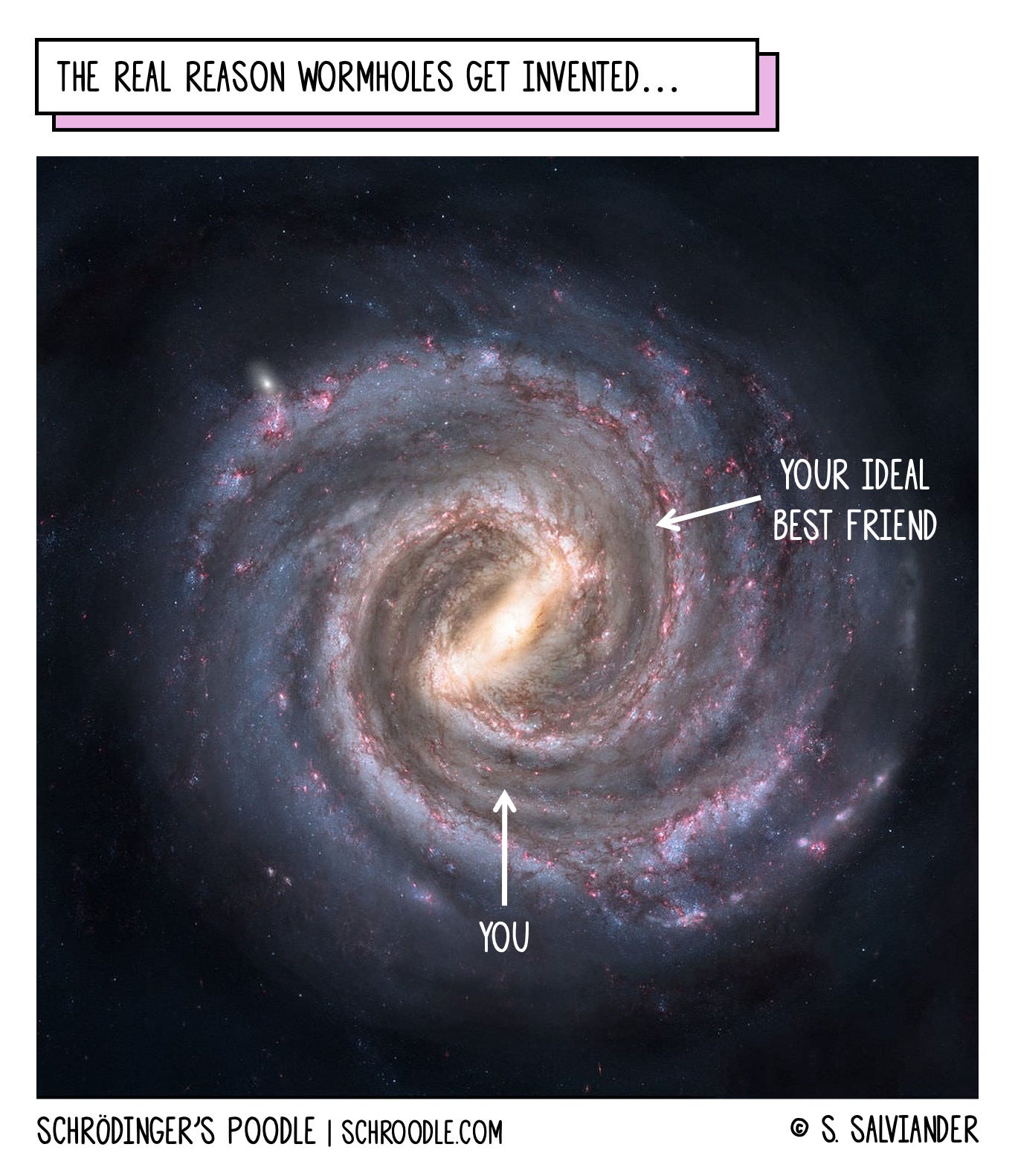
Reach out and touch someone—through an Einstein-Rosen bridge.
If you enjoyed this free edition of “Sunday Superposition,” I’d really appreciate it if you hit the like button below. It helps me see which topics resonate with readers and it boosts my writing. There’s also a share button if you’d like to send this to a friend who might enjoy the science-and-faith conversation.
Please also feel free to comment or ask questions below. If you’re new here, I encourage you to check out my FAQ first.
If you’re a free subscriber and would like to support my work, please consider a paid subscription. Researching and writing these pieces takes time and effort, but I’m committed to keeping my best work—and the vast majority of my content—free for everyone. The generosity of my paid subscribers makes that possible.
Ok, since you brought it up, my one complaint about CONTACT (which I think is the most intelligent extraterrestrial movie out there) is that, in the end, Ellie goes back to her big satellite dishes and headphones to continue her search for extraterrestrial life. After all she just experienced? Really??? I'd be back in that floating chair in that fantastic wormhole machine in a heartbeat. "Good to go—again!"
Other thoughts:
Since I believe that the "universe" was created so we can exist, we ARE "alone" with our creator and His heavenly Son and creatures--a good thing. And that the "universe" in its entirety is all that's required to make us possible. (So where do you think HEAVEN is located?)
In the end of CLOSE ENCOUNTERS, as Neary (Dreyfuss) is about to board that monstrous spaceship, Lacombe (Truffaut) states: "I envy you." Really? Surrounded by those demon aliens for God knows how long, away from Earth for God knows how long? What a Hellish existence.
Not only do I think MARS is a deathtrap for any human exploration (send the machines), I have my doubts about the Moon colonization as well. Sure, what a fantastic exploration opportunity. But other than that, what benefits?
As for this: "People are just as exasperating in space as they are on Earth." Spot on.
Hope all is well.
I too have Asperger's, and I too have always felt "outside" somehow. Attempts to live "inside" never went well, so now I live less sociably, because I am retired, live in the country, and no longer have to work in an office! I've always prayed, even when hopelessly lost in the wilderness of society, of life. And He has always come to find me. I am very sceptical of the existence of any life form created by God that is not of this earth, and the glib: "We cannot be the only intelligent life form in the universe" schtick has always irritated me, because it goes no deeper than that. This article really engaged me, and the excellent writing really swings a potentially vapid topic. Do I believe in angels and demons? Yes. Reptilian "superbeings" from other worlds? No. But I do believe that this obsession with "ETs" and IECs is part of a deeper, darker distraction tactic. Me? I will attend daily mass, order my days around the "Ora et Labora" principle, and delight in the beauty of the earth and heavens, planets and stars, for what they are; God's wondrous work.