


The brouhaha over whether the universe began to exist is one of my favorite scientific debates. It showcases not only how physics inevitably brushes up against metaphysics, but how science is also deeply personal. If you’re one of those “I love science!” people who thinks science is based solely on reason and evidence, I’m delighted to disabuse you of this notion. Science is human and messy. It’s informed by philosophy, religion, and personal preferences to a degree that would make a lot of people uncomfortable if they knew the extent of it. But at the same time, it’s a testament to human cleverness that we’ve come up with a way to study the universe that takes human foibles into account and produces something worthwhile in the long term. I think a lot of that is because God created a discoverable universe that “wants” to be known. If scientists dutifully follow the evidence, regardless of where they began, they’ll get to some understanding of the truth about the universe.
Are we there yet, in terms of the origin of the universe? We’re about as close as we can get. God invites us to explore his universe, but there’s a limit—some things, by their nature, impose a hard boundary to human knowledge.
The process of scientific discovery is often a long and winding one. It took about two thousand years, and a lot of drama, to get to where we are now in cosmology, the study of the overall structure and history of the universe. The story begins with Aristotle (384 - 322 BC), who proposed an eternal cosmos. This view, which was formalized by the Egyptian astronomer Ptolemy (c. 100 - c. 170 AD), persisted for about two thousand years and became the default assumption of physicists, especially by the early 20th century. It also became a cornerstone of atheist thinking—the universe is eternal and therefore needs no God to create it.
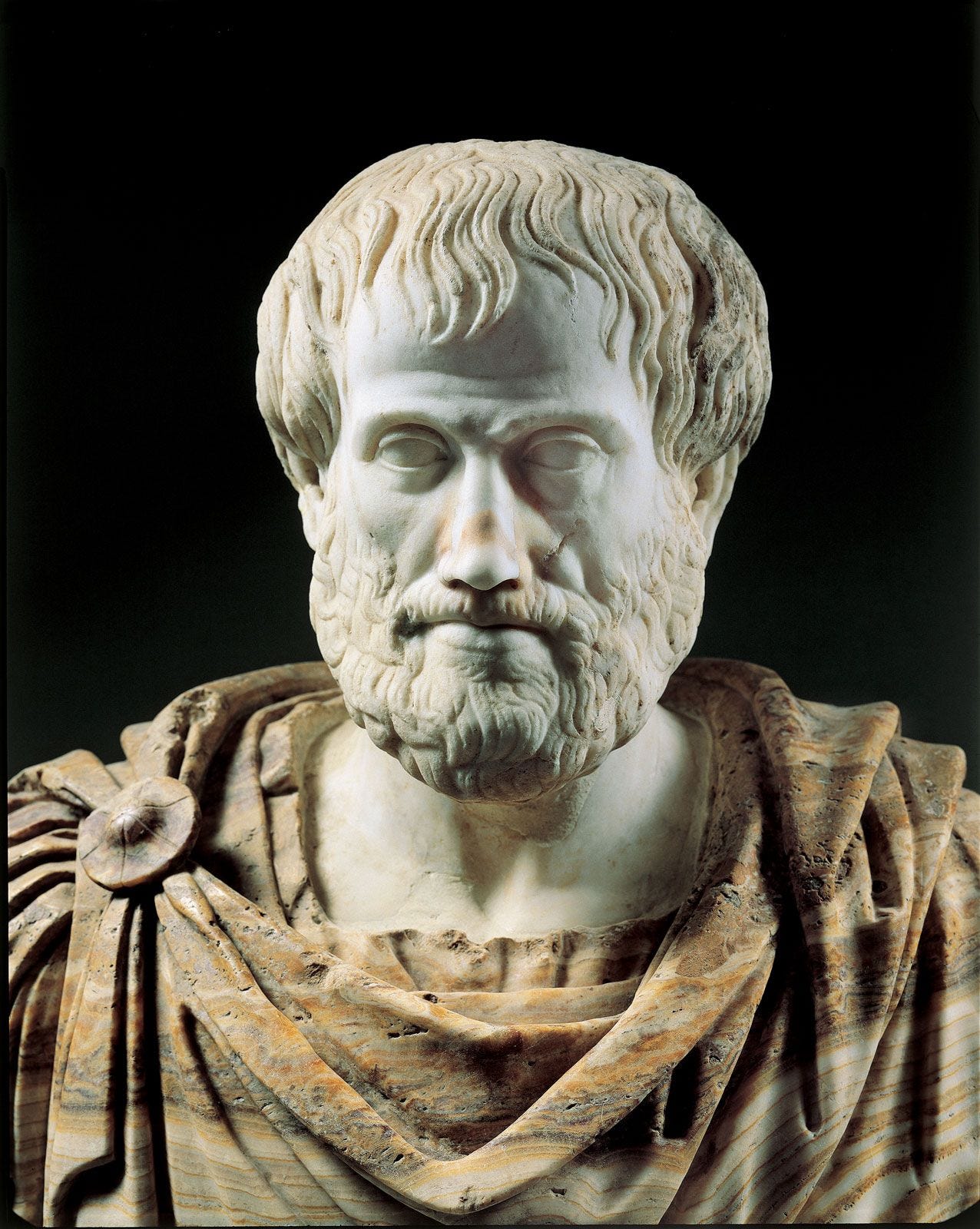
Aristotle’s case for an eternal universe rests on three main points:
The inseparability of motion and time—if there was a first motion, then there would have to be a “before” that is itself outside of time, an impossibility in Aristotle’s view.
Everything that comes to exist is made from pre-existing matter. Nothing comes from nothing, so matter must always have existed; therefore the cosmos is eternal.
The heavens appeared to move in perfect circular motion, the only motion that can continue forever. Because this motion is eternal, the cosmos in which it continues must be eternal.
Aristotle held that whatever is eternal is therefore necessary, not contingent. The cosmos is necessary—it must exist.
Aristotle’s thinking became highly influential. In the 12th and 13th centuries the Church rediscovered Aristotle’s works and became so enamored of them that some medieval thinkers, like Thomas Aquinas, wrestled with how to incorporate Aristotle’s eternal universe into Christian theology. By the 19th and early 20th centuries, the default assumption was that the universe was eternal and uncreated. This became synonymous with “God is not necessary,” and was a real problem for anyone who had a foot in both camps—scientific and theological. The opening chapter of the Bible makes it clear that God created the universe—it’s temporal, not eternal. The universe is contingent, not necessary. How do you reconcile this with the Aristotelian idea of an eternal cosmos? As the Church realized, it ain’t easy.
Aristotle’s reach extended all the way to the 20th century, beginning with Albert Einstein. Though Einstein is known as a towering figure in modern physics, he was essentially a 19th-century scientist, raised and educated in the philosophy and science of the previous century. He was a staunch believer in an eternal universe. And it was poor Einstein who became an emblem for the battle between an eternal and a finite universe.
Most physicists and philosophers at the turn of the 20th century preferred the eternal-universe model. It’s philosophically tidy—the universe is self-contained and self-explanatory—and it seemed to make God irrelevant. Surveys from the early 1900s already showed that a substantial minority of scientists—around 40 percent or more among the more eminent—leaned toward disbelief or doubt, far higher than the general public. Many rested comfortably in the belief that God was unnecessary, at least as far as the existence of the universe was concerned. Meanwhile, Protestants and Catholics mostly stuck to their guns and held that the universe was created ex nihilo. Atheist me, if I had been around at that time, would’ve been fine with that, probably even exultant. Christian me would’ve found it very distressing. But things were about to change.
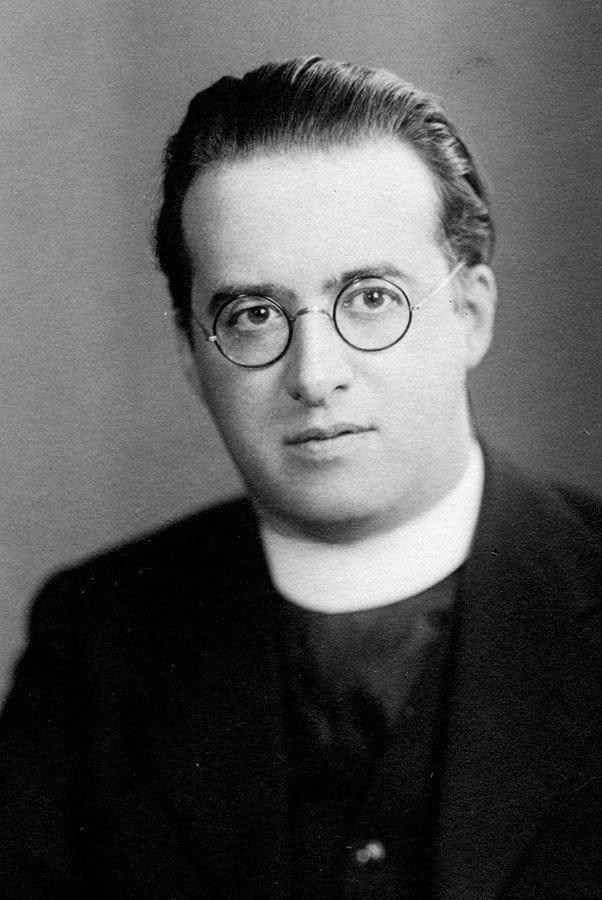
Shortly after Einstein published his General Theory of Relativity in 1915, a mathematician and Jesuit priest named Georges Lemaître solved the theory’s complex set of differential equations and discovered that Einstein’s theory had a mind of its own—it predicted the universe was not static, but expanding with time. This was a profound shock, especially to Einstein, who initially resisted it, telling Lemaître his calculations were correct but his physics was abominable. He even went so far as to arbitrarily wedge a correction factor into his equations to exactly cancel out any overall motion of the universe. It was only after Edwin Hubble, along with his assistant Milton Humason, published their observations showing nearly all galaxies in the universe rushing away from each other—strongly suggesting the universe is expanding—that Einstein grudgingly gave in.
Ironically, it was this overall motion of the universe that led to the idea that the universe was not eternal but finite in time. Unlike Aristotle, whose belief in the intimate tie between motion and time led him to reason that the cosmos was eternal, the expansion of the universe hinted strongly of a universe with a beginning. If you think of the universe as a movie you can fast-forward and rewind, then rewinding the motion of nearly all galaxies rushing away from each other leads to a moment where everything meets at one point—the singularity, the beginning.
Aristotle’s millennia-old cosmology was cracking. The new science of cosmology was born, not peacefully, but straight into turmoil. Physicists got to work exploring the implications of this new paradigm of a universe with a beginning. Most notably, in the late 1940s George Gamow and colleagues predicted that a universe with a beginning would be born incredibly dense and hot and would therefore still have a lingering heat signature—an echo—of the creation event. After billions of years of expansion (implied by reverse-engineering the motions of galaxies), this cosmic background radiation was predicted to have cooled to roughly 5 K, just a few degrees above absolute zero. At the time, no one had a practical way to test it.
Still, atheist physicists were starting to sweat. Not only was their tidy universe hinting at serious loose ends, but God was nosing his way back into the picture. In the 1950s, physicists devised the Steady-State Model of the universe. Proposed by Fred Hoyle, Hermann Bondi, and Thomas Gold, it was an alternative to what Hoyle flippantly called the “Big Bang” model (yes, an opponent of the theory named it and the name stuck). The steady-state model proposed an eternal universe, without beginning or end. The problem was how to contend with the very strong evidence for expansion. How do you have a dynamic universe that’s unchanging? Their solution: new matter is continuously created to keep the overall appearance and properties of the universe constant forever. Where does this new matter come from? No one knows. Hoyle invoked something he called the C-field (for creation field) to give a science-y sounding name to what was effectively magic. It could’ve been called the F-field for fantasy or faith field. Their predicted rate of hydrogen-particle creation was too small to even be tested. You know what’s cosmically ironic about all this? They never got around the problem of the loose end of where the universe comes from. All they did was create the same problem in a different form.
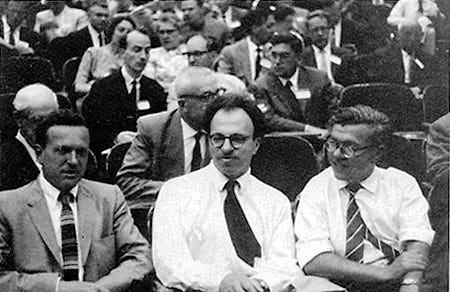
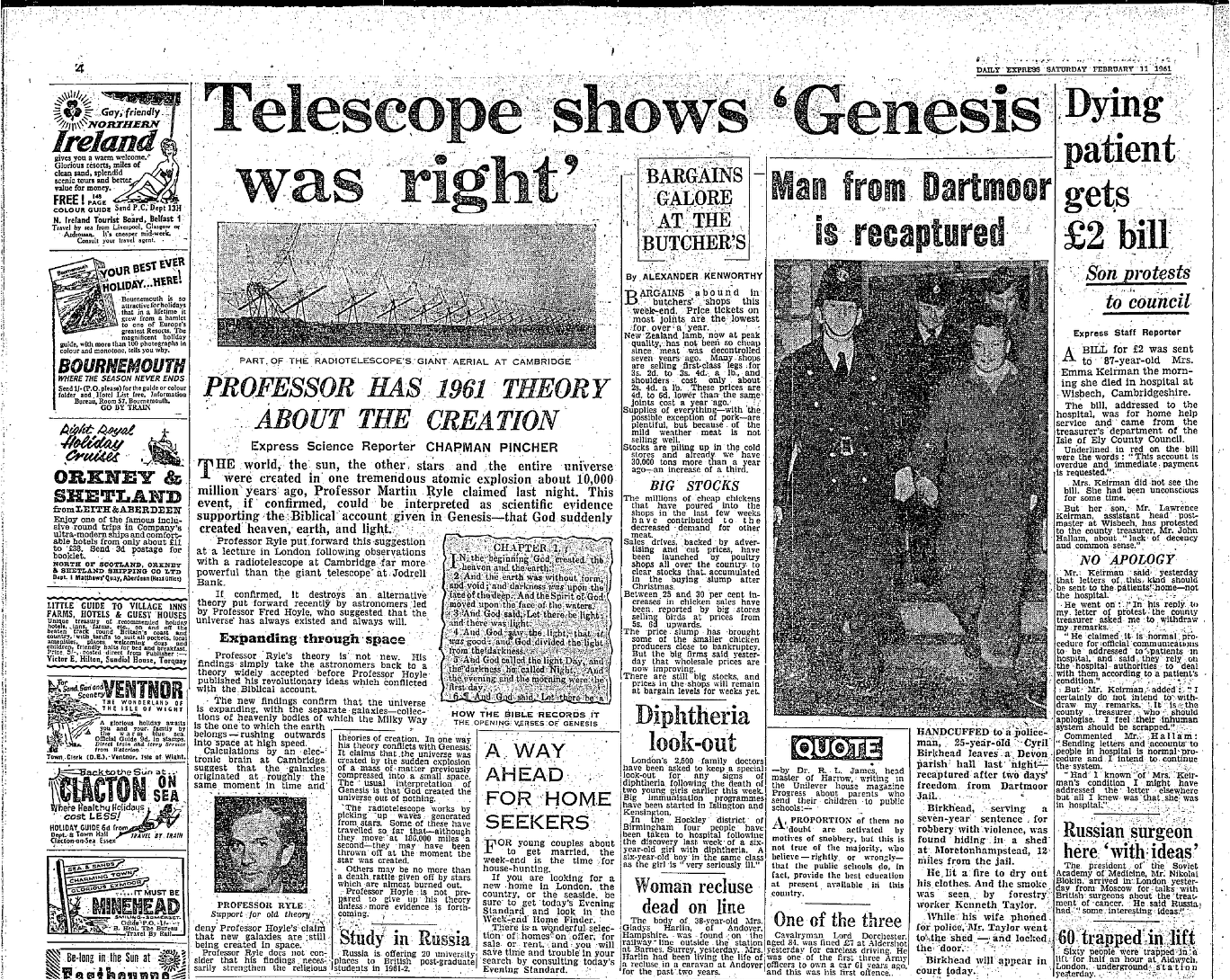
The writing was on the wall for the steady-state model. In 1961, during a meeting of the Royal Astronomical Society in London, astronomer Martin Ryle unveiled new observations in radio astronomy showing the universe was unambiguously evolving with time—something the steady-state model couldn’t cope with. This news was so startling that London’s evening newspapers ran headlines like “Telescope shows ‘Genesis was right.’” It turned out that Ryle’s work had serious source-confusion errors. But people at the time understood the implications—if steady-state was out, God was in.
Later, higher-quality observations confirmed this cosmic evolution. But the big hammer would finally come down in the mid-1960s.
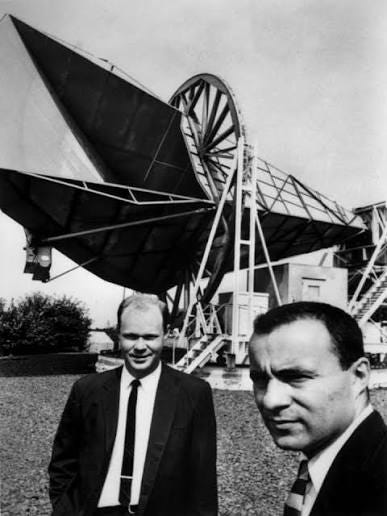
Two physicists, Arno Penzias and Robert Wilson, working for Bell Labs in New Jersey, were calibrating a sensitive horn antenna originally built for satellite communications experiments. While they were at it, they noticed a persistent signal with no apparent source. After ruling out everything they could think of, including scraping off droppings from nesting birds inside the antenna, they had a startling realization. They remembered the prediction by Gamow and his colleagues and realized they had inadvertently discovered the predicted cosmic background radiation (also called the cosmic microwave background or CMB). The temperature associated was about 3–4 K, very close to the predicted number. With no way to explain this, the steady-state model was effectively dead. Rising from the ashes of the eternal universe in phoenix-like fashion was Big Bang cosmology.
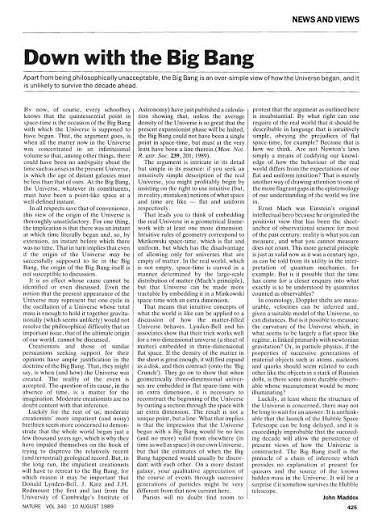
Not every scientist was happy about this. John Maddox, editor of the prestigious journal Nature, said in a 1989 op-ed not-so-subtlely titled “Down with the Big Bang” that the theory was “philosophically unacceptable” and “an over-simple view of how the Universe began.” He hated the Big Bang because it was philosophically messy—the cause, which was beyond the universe, had the nerve to be forever beyond the reach of science. Even worse, it supported the biblical creation narrative. He predicted it was “unlikely to survive the decade ahead,” but he was wrong about that.
Not only did the Big Bang survive the decade, it thrived as the dominant paradigm of physics. In 1989, the same year Maddox published his opinion, NASA launched the COBE (Cosmic Background Explorer) satellite to study the cosmic microwave background. COBE delivered the one-two punch that killed the steady-state model even deader: it showed the CMB is a near-perfect blackbody, meaning it is entirely thermal in nature—the distant echo of some giant heat event. Steady-state has no explanation for that, but Big Bang theory predicted it. COBE also first detected anisotropies, or microscopic fluctuations, in the CMB, which the Big Bang model explained as the seeds of the gigantic structures that would eventually fill the observable universe.
In 1998 another astonishing announcement was made: not only was the universe expanding, it was expanding hard. The universe appeared to be accelerating in its expansion. The light from distant Type Ia supernovae (exploding white-dwarf stars that serve as reliable “standard candles” for cosmic distances) revealed that their host galaxies were too far away for a universe whose expansion was slowing due to gravity. The only way to account for the data was to propose that the universe was speeding up in its expansion. Again, steady-state has no explanation for this.
What Maddox found philosophically unacceptable had developed into the overarching theory of modern cosmology, with an idea that was both simple to understand and rich in complexity. It was now a going concern, a conglomerate of advanced particle physics, chemistry, and astrophysics, all of it testable with particle accelerators, laboratories, and the most advanced telescopes.
There were a few holdouts, like Halton Arp and Geoffrey Burbidge, but nearly every physicist was on board by the 1990s. That didn’t mean they were happy about it or complacent. With no choice but to accept the mountain of evidence, the focus was on getting around the theological implications of a beginning.
In the 1970s, Bryce DeWitt popularized the term “Many Worlds” to describe the work of Hugh Everett III in quantum mechanics. In Everett’s interpretation of the weird world of quantum, all possible outcomes of a quantum event are realized in separate, parallel universes. By the 1980s, the multiverse hypothesis really took off, beginning with the concept of “bubble” universes spawned by the eternal inflation of the universe. This idea was developed notably by Andrei Linde and Alexander Vilenkin (remember this name; we’ll come back to it). The multiverse landscape was expanded by the development of string theory and its implication of an incomprehensible or infinite number of parallel universes, all with different physical laws and constants. This had the double virtue of not only explaining the “beginning” of our universe, but why our universe seems to be so finely tuned for life. It just happened to be one among an infinite ensemble of universes that had the right parameters for life to emerge.
But the multiverse runs into serious problems. Not only is it plagued by a number of absurdities associated with infinities (see Hilbert’s Hotel, Thomson’s lamp, and Gabriel’s Horn) and notoriously difficult if not impossible to test, but a serious nail in its coffin was delivered by none other than one of the proponents of the bubble-universe model. In 2003 Arvind Borde, Alan Guth, and Alexander Vilenkin published their BGV theorem, a mathematical proof showing that, under reasonable assumptions, any universe that has been expanding on average must have a beginning. Even the multiverse, if it exists, must have a beginning. So decisive was this result that Vilenkin remarked, “It is said that an argument is what convinces reasonable men and a proof is what it takes to convince even an unreasonable man. With the proof now in place, cosmologists can no longer hide behind the possibility of a past-eternal universe. There is no escape: they have to face the problem of a cosmic beginning.”
There are critics. One of the reasonable assumptions of the BGV theorem is that the universe must have classical spacetime. That does seem to apply to our universe, but Sean Carroll objects that the earliest moment of the universe is so extreme that it defies explanation by known physics—which is true—and requires quantum gravity to explain it and thus violates this condition of the theorem. In effect, the universe could be in some eternal quantum state before spontaneously expanding in a Big Bang. Critics offer that a bouncing-universe model, or baby universes popping spontaneously from some quantum field, can also get around the BGV theorem.
I believe it’s of the utmost importance to challenge all scientific ideas, even ideas as strong and well-supported as the Big Bang. But at what point does challenge become absurdity? This is what happens when you try to deny the obvious because you don’t like the implications. I know ideas like the multiverse are at least partly motivated to compete with God—I was told so by the late eminent cosmologist Steven Weinberg when I was a researcher at the University of Texas. Personal preference plays its part in science as much as rationality. As George P. Thomson said, “Probably every physicist would believe in a creation if the Bible had not unfortunately said something about it many years ago and made it seem old-fashioned.”
Even so, these attempts to get around a beginning are ultimately pointless, because they’re incapable of rescuing atheists from the reality of God. Aristotle, the father of the eternal universe, found an eternal cosmos still very much in need of God, which Aristotle called the Prime Mover.
Aristotle observed that motion and time are inseparable. He wasn’t just talking about something moving from one place to another (locomotion), but any potentiality becoming an actuality. This includes locomotion, alteration, growth or diminution, and coming-to-be or passing-away. The key is that everything that has motion is moved by something. His definition of time (which is notoriously difficult to define) is: “Time is the number of motion with respect to the before and after.” In other words, time can’t exist without motion, according to Aristotle. And this leads to his idea of the Unmoved Mover or Prime Mover. Since every motion needs a cause, there must be a first cause that is itself uncaused, otherwise you end up with an infinite regression of causes, something Aristotle found unacceptable. The Prime Mover is pure actuality without potentiality and doesn’t physically act on things to move them. Rather, the Prime Mover causes movement as a final cause—the result of an object desiring or loving the Prime Mover.
So the Prime Mover does away with the need for a beginning, but not for an explanation for an ordered cosmos in motion. Motion, order, and contingency all require a deeper explanation. Aristotle was not content to assert that an eternal universe “just is”—to him, it still requires something to “move” it, something that is Actuality without potentiality. And interestingly, this uncreated yet God-sustained universe operates according to the least-scientific force imaginable: love. The heavens revolve as they do because they love and desire the Prime Mover.
I strongly suspect many atheistic eternal-universe proponents are unaware of Aristotle’s not-so-secular philosophical basis for his physics. I certainly wasn’t when I objected to the Big Bang as a first-year atheist physics student. I probably would’ve found it repellant. And while I was certainly in favor of love, I would’ve thought Aristotle was crazy for suggesting it as the driving essence of the universe.
But what if it’s true?
As a Christian, I’m startled by Aristotle’s pagan inference that the essence of the workings of the universe is love. I agree with him. But Christianity inverts his relationship between love and causation: the universe doesn’t move toward God out of love; God created the universe out of his own love.
As C.S. Lewis observed, nearly every religion and tradition gets at least some things right, because there are universal and observable truths. Love is one of them. But Christianity is unique in that its God is personal and relational. He freely creates and sustains. There may be a giant question mark at the beginning of the universe in terms of physics, but for those who believe, there is a comforting end to that loose thread—God the Creator, who knows and cares about every detail in his creation, including you. Who doesn’t stand back from his creation, but actively loves and seeks relationship with the people he created, who bestows providential care, who is holy and righteous and commands us and judges us, who reveals himself through his holy written Word and most tangibly through the person of Jesus Christ, the Logos, the Word personified.

Christians since the time of Aristotle’s re-emergence have been searching for a beginning. We finally found it in modern cosmology. But more importantly, we found an end. The long winding road has finally led somewhere. Not to the insanity of an infinite multiverse with no meaning, not to a bottomless pit of unanswered questions. It has led to an end to our striving, our toiling, our burden, our search for meaning, for belonging, for acceptance, for the love that even pagan philosophers discerned as the essence of existence—we have Someone who fulfills it all and gives us rest.

If you enjoyed the article, I’d really appreciate it if you hit the like button below. It helps me see which topics resonate with readers and it boosts my writing. There’s also a share button if you’d like to send this to a friend who might enjoy the science-and-faith conversation.
Please also feel free to comment or ask questions below. If you’re new here, I encourage you to check out my FAQ first.
If you’re a free subscriber and would like to support my work, please consider a paid subscription. Researching and writing these pieces takes time and effort, but I’m committed to keeping my content free for everyone. The generosity of my paid subscribers makes that possible.
Sarah, what an amazing, inspiring, beautiful, informative, well written and perfect essay. (( had more adjectives, but you get the point). Is this in your book (or some version of it). I mean I knew quite a bit, but learned a whole lot more. And I love the part about love. I think that love (a purely metaphysical thing,) may very likely be a lot more than that. Is gravity a form of love? How about electromagnetism? And once we have life, its all about love. Thank you for this, and God bless.
Sarah, this was a superb piece — not just as a historical survey, but as a window into how deeply human the scientific enterprise really is. You captured something most people never see: the long, winding, often reluctant journey from Aristotle’s eternal cosmos to a universe with a beginning, and how every step forward forced scientists to confront not just data, but worldview.
I appreciated how clearly you showed the pattern: whenever the evidence pointed toward a beginning, the resistance wasn’t scientific so much as philosophical. Einstein’s static universe, Hoyle’s steady-state model with its magical C‑field, Maddox’s “philosophically unacceptable” Big Bang — each one was less about physics and more about protecting a cosmos that didn’t require God. And yet the universe kept refusing to cooperate.
Your treatment of the multiverse was refreshingly honest. The way you traced its rise — from Everett’s quantum interpretation to inflationary bubbles to string theory’s landscape — made the point without polemics: these models weren’t just attempts to explain fine‑tuning; they were attempts to escape the implications of a beginning. And the BGV theorem landing like a hammer was a highlight. Vilenkin’s line about cosmologists “no longer hiding” is one of those moments where mathematics quietly closes a door.
What struck me most, though, was your return to Aristotle. The irony is profound: the father of the eternal universe still couldn’t escape the need for a Prime Mover, and even grounded cosmic motion in love. As you noted, Christianity inverts the direction — not the heavens loving God into motion, but God creating out of love — yet the resonance is unmistakable. It’s remarkable how often honest reasoning leads even pagan philosophers to the edges of biblical truth.
Your conclusion was beautiful. The scientific story doesn’t end in an infinite regress or a metaphysical fog. It ends in a Person — the Logos who created, sustains, and invites. The long search for a beginning ultimately leads to an end of striving, and to the One who gives rest.
A rich, clear, deeply satisfying read.